Imagine a game of telephone at a child’s birthday party. Mom whispers a sentence into a little ear, and the message is passed down in hushed tones, the giggles growing along the way. At the far end of the line, the words emerge unrecognizable, so much hilarious nonsense.
Now, let’s say that the game lasts for centuries, and instead of kids it’s played by white historians who don’t mind stereotyping Native Americans. In essence, that’s how the strange winged creature known as the Piasa Bird came to occupy both the side of a bluff about a mile north of Alton, Illinois, and an important place in that town’s history.
Get a fresh take on the day’s top news
Subscribe to the St. Louis Daily newsletter for a smart, succinct guide to local news from award-winning journalists Sarah Fenske and Ryan Krull.
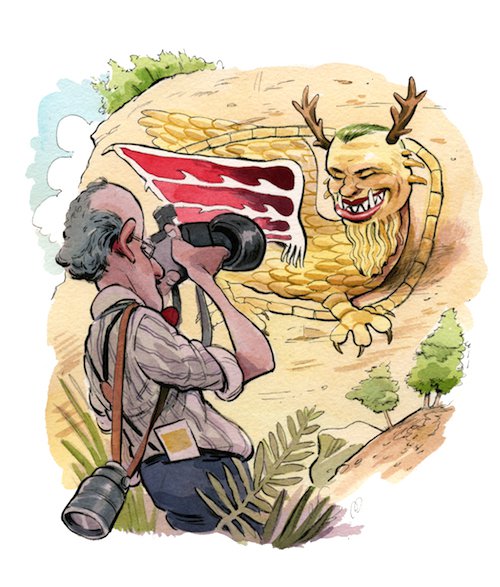
In 1673, when explorers Louis Jolliet and Jacques Marquette were mapping the upper Mississippi, they came upon “two painted monsters,” as Marquette wrote in his journal. Each had horns like a deer, a body covered in scales, a long tail, and a bearded face with menacing red eyes. Showing the prejudices of the time, Marquette added that the images were “so well painted that we cannot believe that any savage is their author; for good painters in France would find it difficult to paint so well.”
Over the years, outlandish theories were put forward to explain the paintings’ origins. Some said that perhaps ancient Chinese explorers had brought dragon lore to the Midwest. Others argued the 10 lost tribes of Israel had painted the monsters as a warning of the Apocalypse. In 1836, John Russell, a novelist known for frontier fiction, settled the dispute with a story that was equally phony but much more persuasive. In a magazine article, he explained that the monster was called Piasa, or the “bird that devours men.” (Marquette had forgotten to mention the wings, apparently.) The dragon lived in a cave full of bones and wiped out entire Illini villages. To rescue his people, Chief Ouatoga set a trap for the Piasa, offering himself as live bait. When the bird showed up, warriors hidden in the forest fired poison arrows, slaying the beast.
Of course, this story is ridiculous, its only source Russell’s overactive imagination. Still, it’s stuck. Since the 1920s, murals and statues depicting Russell’s version of the bird have been displayed prominently in Alton. In 1998, local artist Dave Stevens painted the current Piasa Bird, roughly 50 feet wide and two stories tall.
“The representation we see today and the story that goes with it are not authentic Native Americana,” says John Dunphy, historian, author, and owner of the Second Reading bookstore in Alton, “but it’s certainly helped to give Alton its identity.”