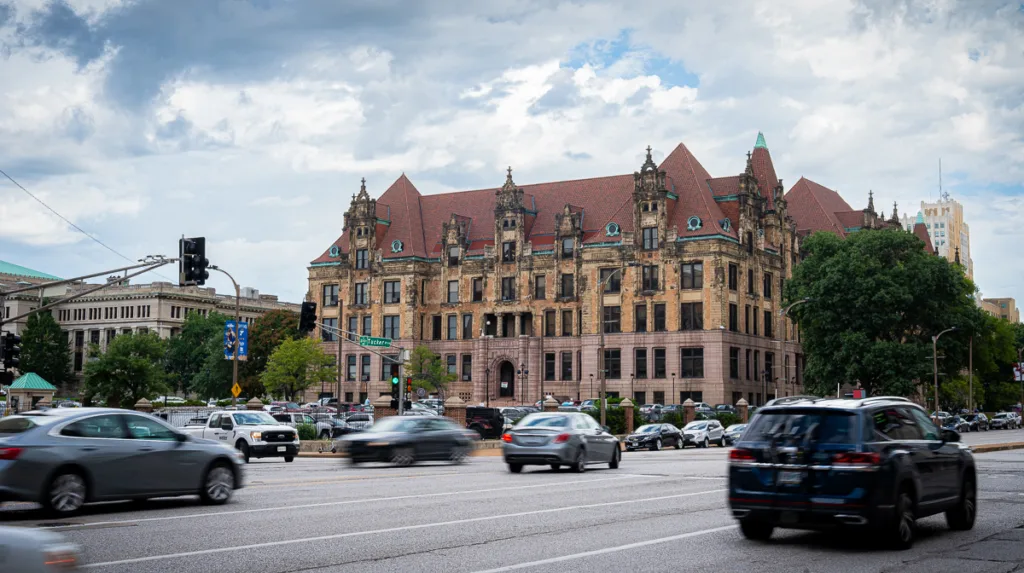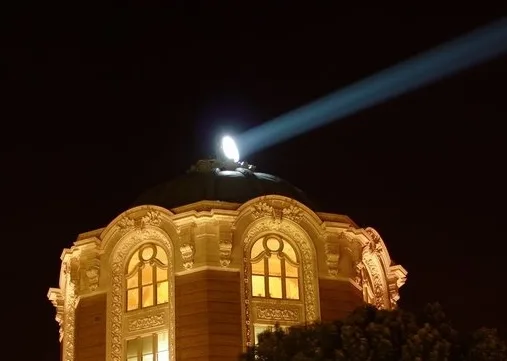
Above the City Council chambers in University City, past the ornamental ceiling and tucked inside a roof that opens to the sky, rests a five-ton searchlight. It was designed to draw eyes—to be impossible to miss. But more than a century after U. City founder Edward Gardner Lewis had it installed to attract visitors during the 1904 World’s Fair, the device mostly attracts questions.
A searchlight? On The Loop? Why? Does it work?
Get a fresh take on the day’s top news
Subscribe to the St. Louis Daily newsletter for a smart, succinct guide to local news from award-winning journalists Sarah Fenske and Ryan Krull.
That’s if folks even know it’s there. “There are so many people that I’ve talked to and they’re like, ‘I had no idea about this,’” says Eric Kusnierkiewicz, vice president of the Historical Society of University City. “They might live a block away from there and have no clue because this thing’s just been hidden in this roof. It’s a shame.”
Kusnierkiewicz is among a group of lovers of local lore hoping to change that.
The Historical Society is leading an effort to restore the searchlight and return it to regular use during special events. The project received a boost this week when City Manager Brooke Sharp confirmed to SLM that she included $45,000 for needed repairs in the fiscal year 2027 budget, which the City Council approved Monday night.
The light itself works. So, too, does the elevator that raises it from the roof. Sort of. The funding is expected to address what Kusnierkiewicz describes as the largest remaining obstacle to bringing the searchlight back into service.
“The problem is that the elevator is off balance,” he says.
That’s no small concern, either. Before the light can shine, two sections of the roof must open. The elevator then rises the light into position. But if the system fails while the searchlight is out, Kusnierkiewicz worries the city could be left with a historic machine stuck in place and no easy way to bring it down.
“If the light comes out of the roof and refuses to go back inside and we ruin the council chambers, I’m dead,” Kusnierkiewicz says. “Also, nobody sees this thing ever again.”
The light, of course, was built to be seen.
Lewis had it installed atop his Woman’s Magazine publishing headquarters, which later became City Hall, in 1903 as he prepared for the crowds expected to descend on nearby Forest Park during the following year’s World’s Fair. The light beam was both a technological marvel and, maybe more importantly, a marketing device meant to draw attention to the nearby community and his budding editorial empire.
“He was a publicist, basically in the original sense of the word,” Kusnierkiewicz says. “He shone this over the World’s Fair and drew people over. Hey, while you’re here, do you want to subscribe to the magazine? Do you need a hotel for the night?
With the right repairs, Kusnierkiewicz believes the searchlight could still accomplish what it was built to do.
“Let’s use it for the original intent,” he says. “Let’s use it as a marketing ploy. Let’s draw people to the city.”
The searchlight, which measures roughly 80 inches across, remains a source of engineering fascination. Although it has undergone repairs and modifications over the years, much of its historic infrastructure remains intact. Its operation still relies on carbon rods that create an intensely bright arc of light.
“We could hit the Arch with it,” Kusnierkiewicz says.
For the Historical Society, the restoration effort extends beyond the equipment. There needs to be a project plan that details maintenance schedules, safety policies, operating procedures, and other long-term guidelines meant to prevent the searchlight from slipping back into obscurity. Kusnierkiewicz says it has already experienced multiple cycles of neglect and rediscovery. He points to the work of assistant city engineer Robert Norvell, who helped revive the light in the 1960s, and longtime caretaker Bill Kaufman—he’s the son of former U. City Mayor Nathan Kaufman—who has helped maintain the machinery for decades.
“My goal is that we never undiscover this light again,” Kusnierkiewicz says. “If I, God forbid, get hit by a bus, somebody knows how it works.”