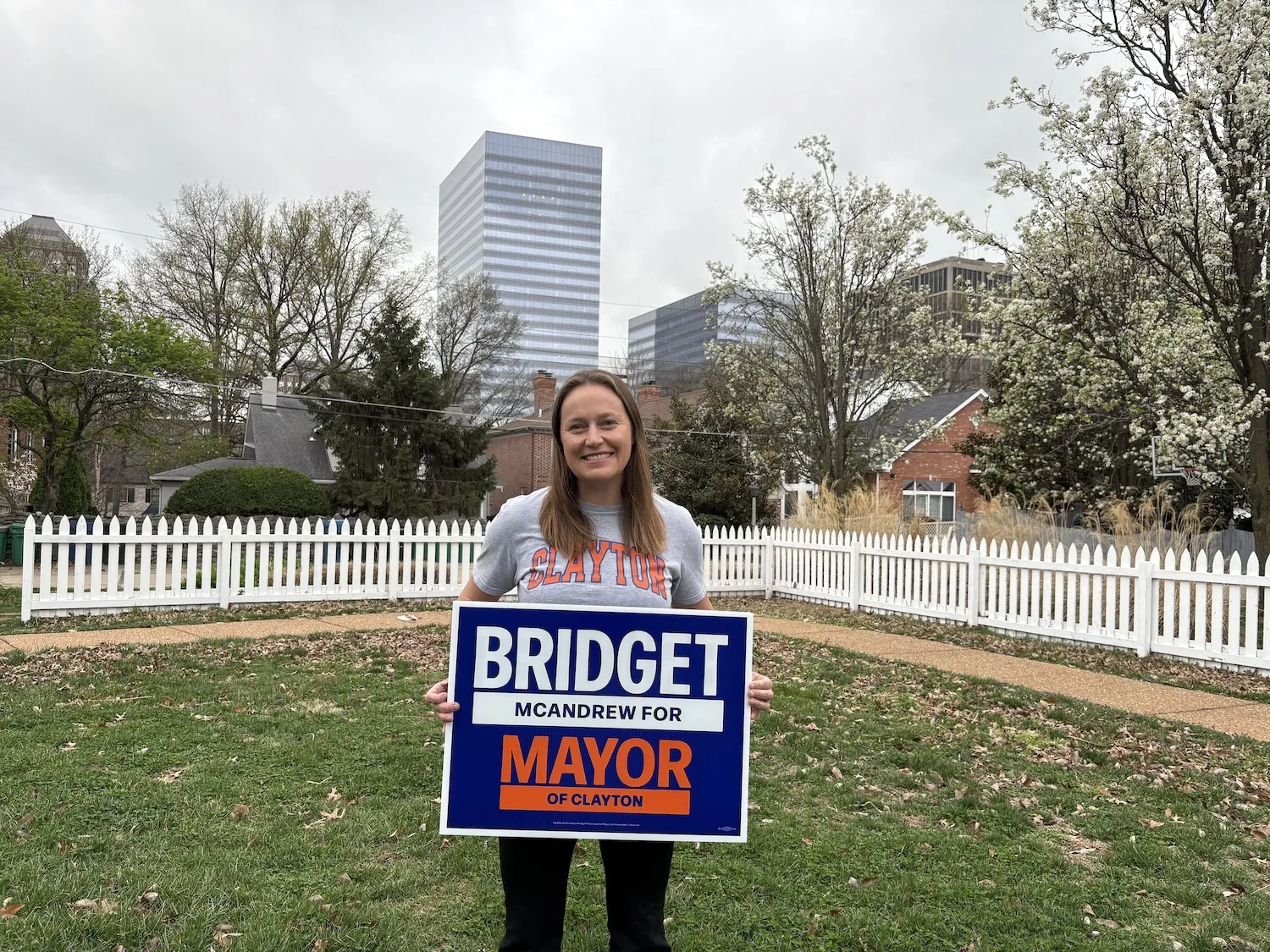
On April 22, Bridget McAndrew took her oath of office as Clayton’s mayor. Twenty-four days later, she experienced her first major test. The EF3 tornado that devastated a 23-mile swath of the St. Louis region touched down in her municipality on the afternoon of May 16, thrusting McAndrew into emergency response mode. What is technically a part-time job for McAndrew, an attorney by trade, quickly required a full-time focus. “There were about 10 days where we were at City Hall constantly, from morning till night,” McAndrew says.
While Clayton—and the metro area—continues to navigate the aftermath of the natural disaster, McAndrew has faced other, more recent challenges, including responding to the city’s first armed robbery of 2025, as well as an antisemitic hate crime that has drawn the attention of federal investigators. Now more than 100 days into her term, McAndrew reflects on her whirlwind start, lessons learned from crisis management, and her vision for Clayton’s future.
Get a fresh take on the day’s top news
Subscribe to the St. Louis Daily newsletter for a smart, succinct guide to local news from award-winning journalists Sarah Fenske and Ryan Krull.
The tornado
McAndrew’s first month as mayor included uprooted trees, damaged homes and infrastructure, and weeks of repairs and restoration. She credits fire chief Ernie Rhodes for creating an incident command system and city manager David Gipson for corralling resources as Clayton navigated the storm’s aftermath. “We hit the ground running that night,” McAndrew says.
The city has since shifted from emergency response mode to long-term recovery. Last month, Clayton applied for disaster assistance from FEMA to help cover costs associated with debris removal and the restoration of public infrastructure, among other needs. Meanwhile, Clayton is navigating new contracts for sidewalk repairs that will replace more than 200 slabs of walkway, backfill tree lawns, repair curbs, and more. McAndrew says the city has also contracted with the Lochmueller Group to create redesign plans for the median along Wydown, which was hit hard during the storm. “We also had a tremendous amount of street lights that were out,” she says. “We’re still evaluating all the different street lights that need to be repaired.”
The tornado took an especially severe toll on the city’s tree canopy, with approximately 600 trees lost. Many of the locations where those trees once stood still require stump removal, a process McAndrew says will take a long time to execute. “Our trees took an incredible hit,” she says. “It’s a difficult thing. I’ve learned a lot about trees in the last three months. We’re working with arborists at the Missouri Department of Conservation to make sure that, as we plant new trees, we’re planting the right trees.”
Recent crime
Although the city has one of the lowest crime rates among municipalities in the metro area, two recent violent incidents have captured headlines.
On July 19, two people were robbed at gunpoint at the intersection of North Central and Pershing. The victims reported that two young males wearing hooded sweatshirts and face coverings followed them as they walked. One of the alleged assailants then pushed the male victim to the ground and assaulted him. Late last month, Clayton police arrested two suspects—an 18-year-old man and a juvenile.
“We don’t have a lot of violent crime in Clayton. Whenever there’s any sort of instance such as an armed robbery, for example, it’s certainly unsettling,” McAndrews says. “In this case, we had a couple that was walking home from dinner, which I think everybody in Clayton treasures that walkability that we have. Thankfully, because of all the cameras—on commercial buildings and really more on the residential homes—police were able to identify the suspects quickly. It was very unsettling, but police were able to resolve this pretty quickly.”
Then, in the early hours of August 5, officers responded to a call in the 7500 block of Westmoreland, where three vehicles were set ablaze in a fire believed to be intentionally set. Responding officers say they also identified antisemitic graffiti in the street. In addition to the Clayton Police Department, the FBI and the St. Louis Regional Bomb and Arson Unit are investigating.
McAndrew declined to comment on the investigation due to the ongoing police work, but said she was heartened by the community response she encountered during a gathering at Kol Rinah congregation on Maryland Avenue two weeks ago.
“Our community is very resilient—our Jewish community is very resilient,” McAndrew says. “I think people felt comforted to hear from all the faith-based leaders who spoke out against it. There was a representative from our police department that spoke, and the FBI special agent in charge spoke. I know that everybody was happy to hear from them as well.”
Downtown and development
Beyond special events, such as the recently-relocated Taste of St. Louis and the annual St. Louis Art Fair, downtown Clayton streets can feel sleepy and empty outside of standard business hours. As the city recently updated its comprehensive plan—it was adopted in June 2024—residents overwhelmingly said they’d appreciate a more vibrant downtown.
“We’re certainly looking at ways to do that,” McAndrew says. “I’ve spent some time meeting with developers and retail experts to understand some of the things that are holding us back. It continues to be very high land values and high rents. Doing any sort of construction … costs are significantly higher than they were even just four years ago.”
That said, Clayton has enjoyed some recent wins on the entertainment front. Five Iron Golf (8027 Forsyth) opened on the ground floor of the Emerson Tower in June, and Flight Club (7710 Forsyth)—billed as a high-end, tech-driven darts venue—opened in the former Cantina Laredo space earlier this year.
The city also recently decided not to renovate and rebuild Shaw Park Ice Rink, which McAndrew says reached the end of its functional lifespan prior to the pandemic. The goal is to reimagine the location as a flexible event space, which could include permanent pickleball courts.
One of the city’s biggest priorities is seeing to the finish line Caleres’ sale of its campus to Opera Theatre of St. Louis, which went under contract for the 6.7-acre space earlier this year. OTSL has said it plans to raze the site’s main building and launch construction on a new performing arts center in its place. Although she doesn’t have much sway in the deal, McAndrew says she understands that the process continues to move forward.
“Our citizens want more cultural opportunities in Clayton, and this type of thing is hard for a municipality to build,” she says. “To have Opera Theatre at that site would be such an asset to our community and an asset to our school district. I’m hopeful that they are moving down that path and that the plan will go forward.”