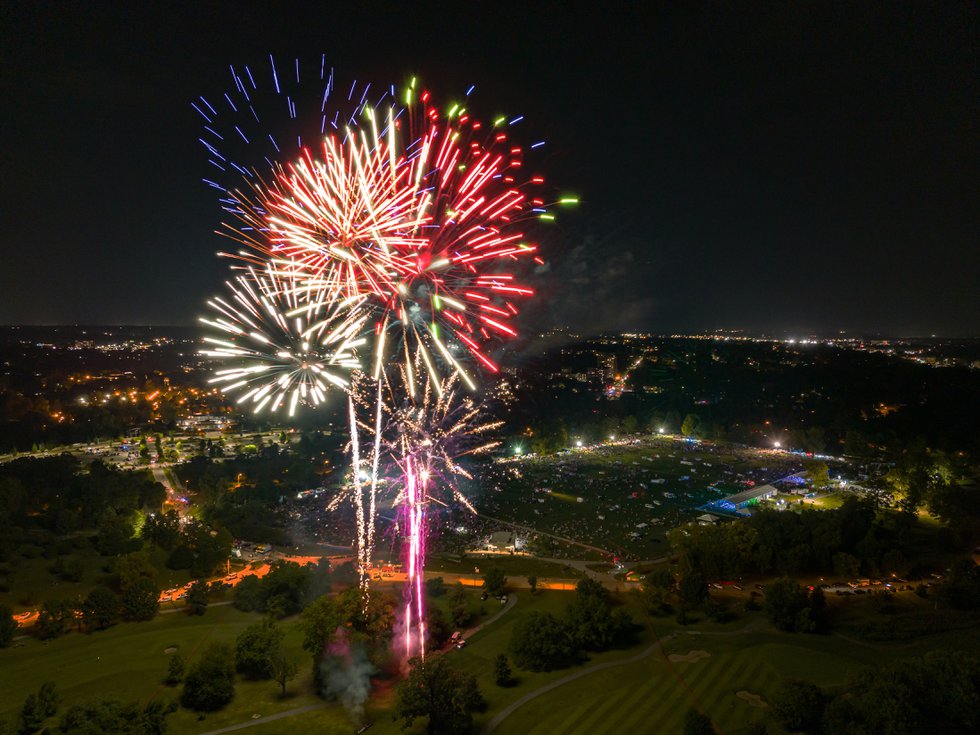
Towns across America have been preparing for years to celebrate July 4 in a big way since it falls on the 250th anniversary of America’s founding. But costly tariffs that the Trump administration slapped on Chinese-made fireworks and historically high demand have led some communities to pull the plug on their fireworks shows or get extra creative in trying to fund them.
The city of Ferguson announced last month it is cancelling its July 4 fireworks show because of price increases caused by the tariffs, doubling the cost of their annual pyrotechnics bill to $40,000.
Get a fresh take on the day’s top news
Subscribe to the St. Louis Daily newsletter for a smart, succinct guide to local news from award-winning journalists Sarah Fenske and Ryan Krull.
Meanwhile, the city of Kirkwood has had to lean extra hard on private donors to make up the budget gap caused by a sharp increase in fireworks prices related to tariffs, raising the cost of this year’s July 4 show by $9,500, according to Kyle Henke, the city’s parks and recreation director. “That’s a $35,000 show,” Henke says.
As a result of the higher costs, he says, “The group of people that typically do the fundraising decided they’d do a bit more and try to get more to cover the cost. And right now I think they covered 90 percent of the fireworks this year.”
One of the region’s biggest fireworks shows has traditionally been the JB Blast at Jefferson Barracks Park in St. Louis County. But in March, St. Louis County Executive Sam Page announced the show’s cancellation because the county did not have the money to pay for it. The event typically costs $50,000, Page said, which is used to buy fireworks, fill concession stands, hire bands, and rent portable toilets.
Page’s announcement follows a period of financial turmoil on the St. Louis County Council over the current year’s budget, leading council members to cut millions of dollars from a variety of programs.
Slightly more than a year ago things were looking grim for the fireworks industry.
The Trump administration had imposed a 145-percent tariff on Chinese fireworks in early April 2025 as part of an escalating reciprocal trade war. The tax was lowered to 30 percent one month later when the two countries agreed to a 90-day pause. The rapid succession of these tariff hikes caused major disruptions for U.S. fireworks distributors, as 99 percent of consumer fireworks used in the U.S. are imported from China, according to Ed Vasel, vice president of the National Fireworks Association.
Tariff rates on imported Chinese fireworks currently stand at 25.3 percent for consumer fireworks and 22.4 percent for display fireworks.
Many towns and individual fireworks customers are feeling the pinch this year because the fireworks industry runs on a one- to two-year order process, Vasel says.
“We didn’t see a lot of price increases last year when the tariffs were at their worst,” he says. “The majority (of fireworks) came in pre-tariff. Now as that product has revolved and sold since last year, it was replaced with mostly tariffed product. “
But because so many towns are going all-in on extravagant fireworks shows with lavish grand finales to celebrate 250 in a big way, the demand for display fireworks is greater than ever—which is bad news for venues that ordered too late.
“And they’re being turned down this year because the fireworks display industry simply does not have the capacity to serve them all,” Vasel says.
Some St. Louis County towns were not affected by the fireworks tariffs because they had already signed multi-year agreements with suppliers before the tariffs took effect.
Webster Groves is in the third year of a three-year contract to buy display fireworks for a 25-minute show on July 4 at Memorial Park that’ll cost $25,000 to put on, according to James Boyd, the city’s parks and recreation director. “We were under contract last year, so we were good,” Boyd says.
Webster Groves plans to celebrate Independence Day with a public reading of the Declaration of Independence in front of City Hall on July 1 and play host to thousands of marchers and 73 floats during the annual Community Days Parade on July 4 through the heart of the city.
The city of Florissant stages a big fireworks show every July 4, but it also doesn’t expect to pay more this year for pyrotechnics. That’s because it too is in a multi-year contract with its supplier that was signed before the tariffs took effect. “So it hasn’t really affected us at the moment, I guess you could say,” says Patrick Mulcahy, the Florissant city manager.
By far, America’s biggest fireworks show will occur in Las Vegas, with the America250 celebration that will launch pyrotechnics from 15 locations on the Las Vegas Strip and across the Las Vegas Valley, including the rooftops of six casinos and the 1,149-foot Stratosphere Tower, according to Phil Grucci, the CEO of Fireworks by Grucci, which is putting on the Las Vegas show.
Several years ago it looked as if synchronized drone displays would replace traditional fireworks shows. But fireworks shows have since rebounded strongly, says Grucci, whose family-owned firm has operated continuously since 1850.
The entertainment value of a drone show “is not nearly as good as a fireworks show,” Grucci says. “It’s that power. It touches all the senses. It’s an artistic expression in the sky. There’s nothing like it.”