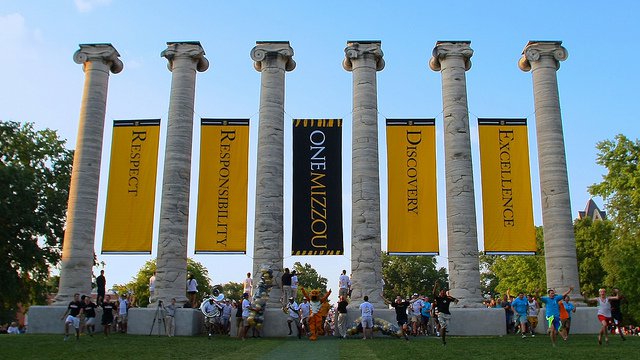
Especially in St. Louis, it’s almost impossible to talk about the recent turmoil at Mizzou without mentioning Ferguson.
As news spread of UM Systems President Tim Wolfe’s resignation Monday, references to Ferguson were common both in news outlets and on social media—sometimes as context to understanding Missouri’s overall racial climate, sometimes as a direct comparison to the disruptive protests often led in both places by young people, especially by students and women.
Get a fresh take on the day’s top news
Subscribe to the St. Louis Daily newsletter for a smart, succinct guide to local news from award-winning journalists Sarah Fenske and Ryan Krull.
See also: UM President Tim Wolfe Resigns After Student Protest Over Racist Incidents
The unrest in Ferguson was certainly on graduate student Jonathan Butler’s mind before he started the hunger strike that would inspire the football team boycott and eventually convince Wolfe to step down. Less than 48 hours before his hunger strike began, Butler returned to Ferguson, where he’d spent a weekend after Michael Brown’s death helping protesters avoid tear gas and rubber bullets, and said he’d found a renewed sense of purpose.
Make no mistake: The protests in Ferguson and at Mizzou have more differences than similarities. As repulsive and hateful as a swastika drawn with feces in a dorm is, it doesn’t inspire the same fear in young people of color as a police officer’s bullet lodged in the limp body of an unarmed black teenager. Chanting, not gunfire, was the soundtrack to the unrest at Mizzou.
But the protests’ similarities—in method, in message, in efficacy—are worth noting, if only to wonder why the university didn’t have a stronger immediate response to the recent racially motivated incidents on campus in a post-Ferguson world.
“There was national coverage, so for the school to not cover [Ferguson] or really address that, and we are only two hours away, I think was a huge mistake on their part and contributed to the current cultural environment that we have,” Butler told The Washington Post on Friday. “It just shows that there are racially motivated things—murders, assaults, other things—that happen, and we are just going to sweep them under the rug.”
Football’s impact
SLM noticed a few interesting similarities from watching protests in both Ferguson and Columbia. For starters, there’s the strange effect that football had on both places by amplifying protesters’ messages into the mainstream.
Barely an hour after Wolfe stepped down, The Washington Post ran a new headline: “How the Missouri football team just took down its university president.” Of course, the University of Missouri Tigers didn’t “take down” Wolfe. Student, faculty, alumni, and lawmakers speaking up for the growing and urgent need to change Mizzou’s racially tense climate did. But it was the football team that got the most attention.
On Saturday, defensive back Anthony Sherrils posted a photo of more than 30 African-American players, their arms linked in solidarity, with a statement that said, “We will no longer participate in any football related activities until President Tim Wolfe resigns or is removed due to his negligence toward marginalized students.” By Sunday, Tigers head coach Gary Pinkel tweeted his own photo, this time with the entire team locking arms, supporting the players’ boycott against practicing or playing in an upcoming game, which would have cost the school $1 million.
The Ferguson movement got a boost from football, too, back in November 2014, when five black St. Louis Rams players took the field at the Edward Jones Dome with their arms raised in the “Hands Up, Don’t Shoot” gesture associated with Brown’s death.
Kenny Britt, Tavon Austin, Stedman Bailey, Chris Givens, and Jared Cook said their pre-game stunt was an act of solidarity with Ferguson.
“Everything about the situation touched me because it could have happened to any of us,” tight end Cook told the Associated Press afterward. ”Any of us are not far from the age of Michael Brown, and it happened in our community. I wouldn’t want to be in any one of those guys’ situations that it happened to.”
Nothing new
In Ferguson, residents were complaining about predatory court systems and bad-apple police for years before Brown’s death. Similarly, students at Mizzou have been reporting racist incidents for years, as former Missouri basketball player Kim English said this weekend on Twitter:
“If U were black at my alma mater, and ur name was not Maclin, Denmon, Pressey, English, Weatherspoon, Carroll, etc. You didn’t feel welcome,” English continued on Twitter.
Even the racially motivated incidents that inspired Mizzou’s most recent protests, such as the white students who hurled the n-word at student body president while driving across campus, find company in the school’s not-so-far-off history. In her opinion piece “I was a black student at the University of Missouri. Racism there is nothing new,” Mashable political editor Juana Summers shares memories of Mizzou from before Wolfe became president:
[Wolfe] wasn’t the university system president in 2010 when two white students threw cotton balls onto the lawn of the school’s black culture center and were later convicted of … littering. Nor was Wolfe at Mizzou when, in 2011, a student painted a racist slur outside a residence hall. Wolfe also wasn’t on campus the day students threw a beer bottle at me from the balcony of an off-campus apartment building. My offense? Daring to date someone of a different race and to leave a party with him…Mizzou is where I met my closest friends and fell in love with journalism, but it is also where I was called a n*gger for the first time that I can remember.
Summers’ gruesome story sounds like something you’d hear in 1955, not 2015. To offer more (recent) historical context, Washington Post reporter Wesley Lowery, who was one of the journalists arrested in Ferguson for not leaving a McDonald’s quickly enough, broke down how Ferguson’s cultural influence impacted Mizzou:
But Ferguson’s effect on Mizzou’s recent racial turmoil is also more direct than Lowery’s contextual timeline suggests. Sometimes, the same faces are spotted at protests both at Mizzou and in Ferguson:
One of the founding members of Concerned Student 1950, the campus activist group named after the first African-American student admitted to Mizzou, also demonstrated during the Ferguson unrest:
Before Wolfe’s resignation, Poole told the Los Angeles Times about the time that a man used the n-word while kicking her out of a fraternity party during her freshman year. She described Ferguson’s influence on the Mizzou protests as “a domino effect.”
Whether there’s a domino effect or the oft-cited “Ferguson effect,” one thing is clear: Ferguson was just the beginning.
Contact Lindsay Toler by an email at [email protected] or on Twitter @StLouisLindsay. For more from St. Louis Magazine, subscribe or follow us on Facebook and Twitter.