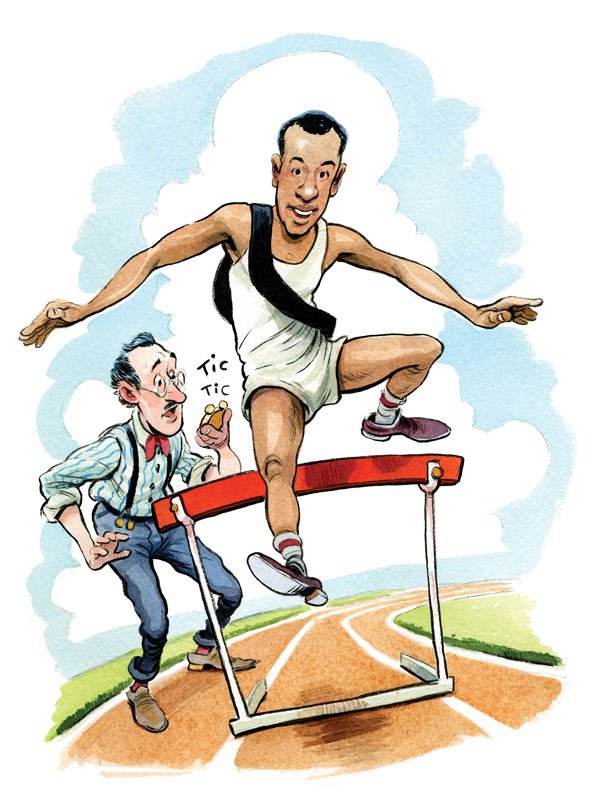
The caption next to George Poage’s photo in his college yearbook reads, “Of matchless swiftness, but silent pace.” Throughout his life, Poage was an anomaly. In death, he’s become an enigma.
Poage was born in 1880 in Hannibal, before spending most of his childhood in La Crosse, Wisconsin. Despite the death of his father and two siblings in close succession, Poage enjoyed a privileged upbringing, thanks to his mother, Anna, who served as stewardess to a wealthy businessman. George was the salutatorian of his high school class and went on to the University of Wisconsin, where he was a noted scholar and athlete. He became the first black Big Ten track champion in 1904, when he finished first in the 440-yard dash and 220-yard hurdles.
Get a fresh take on the day’s top news
Subscribe to the St. Louis Daily newsletter for a smart, succinct guide to local news from award-winning journalists Sarah Fenske and Ryan Krull.
The 1904 Olympics in St. Louis was little more than a sideshow for the World’s Fair, and the competition was utterly disorganized. (Another time, ask me about the bizarre marathon run at those games.) Few foreign athletes came, and most African-Americans boycotted the games to protest Jim Crow segregation. But Poage decided to compete. On August 31, he finished third (of four) in the 400-meter hurdles, making him the first African-American to win an Olympic medal. He captured another bronze the next day in the 200-meter hurdles.
Shortly after the Olympics, Poage returned to St. Louis and took a job at Sumner High School. “He was on the fast track there to become important,” says Bruce Mouser, a professor at the University of Wisconsin–La Crosse, “and then it all ended.” Poage was forced to resign under mysterious circumstances. According to a 1914 article in the Argus newspaper, Poage was “one of three teachers against whom charges had been filed before the board involving their moral character… A startling condition of affairs was disclosed.” What was that condition of affairs? If you can figure that out, I’ll gladly name you an honorary St. Louis Sage.
Poage retreated into himself. He moved to Chicago, where he worked as a mail clerk. He never married and lived with his mother. His funeral procession included just two cars, and he was buried in an unmarked grave. Only recently did he gain some recognition. La Crosse is renovating a park that will be renamed in Poage’s honor, and Viterbo University professor David Waters led the charge to add a headstone to Poage’s final resting place. It’s inscribed with that quote from his yearbook, which foretold the befuddling juxtaposition of his great talent and his anonymous end.
1904 Olympics Facts and Figures
239 medals won by the United States. Germany claimed the second most, with 13. The 1904 Olympics was the first at which gold, silver, and bronze medals were awarded.
94 events, with competition stretching over nearly five months
6 medals awarded to George Eyser, an American gymnast with a wooden leg
5 members of a team in tug of war, which was an officialOlympic event
4 events that made their debuts: boxing, wrestling, the decathlon, and dumbbells