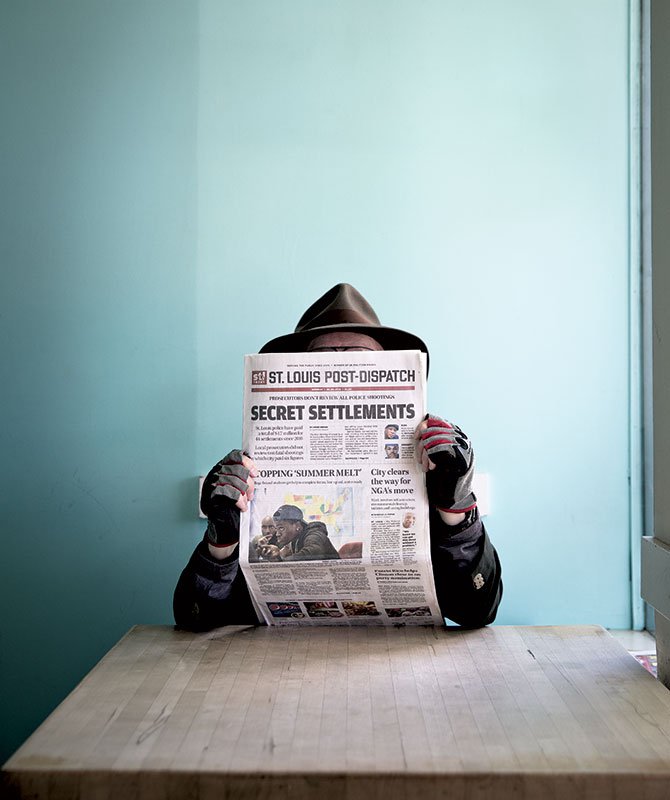
In his 34 years at the St. Louis Post-Dispatch, Michael Sorkin dug into some of St. Louis’ most lurid cases, and he never let go. Nor has he forgotten a single incidence of his former editors’ “journalistic cowardice”—he’s referred publicly to the “series of mostly mean, sometimes alcoholic, or just plain weasel-like top editors who have cycled through the newsroom during past decades.” His final gig there was writing obits. But Sorkin doesn’t want to whine or blame the newspaper’s current staff: “I’m very proud of them,” he says. “They are working their butts off with fewer resources than they’ve ever had.” Every morning he goes out at 6 a.m. with his dachshunds and redelivers the papers, lest they get soggy at the curb.
What did you want to be when you grew up? I tried to be a nice little Jewish boy for about five minutes, and I thought I wanted to be a rabbi. And then when I was 12, I wanted to be a doctor. Do you see a pattern here? This is not me pleasing me, this is me pleasing my parents. At 12—are you ready?—I was a candy-striper at the old Jewish Hospital. I had a little white smock. Found out I couldn’t stand the sight of blood—particularly my own.
Get a fresh take on the day’s top news
Subscribe to the St. Louis Daily newsletter for a smart, succinct guide to local news from award-winning journalists Sarah Fenske and Ryan Krull.
How’d you wind up on the staff of your college newspaper? I put a Playboy pin-up on my dorm-room bulletin board, and the housemother took it down. I wrote a letter to the editor. It must have resonated.
You were the editor of your college newspaper. Were you tough back then? I got the dean of students fired. I’d gotten the documents, some secret plan he had to deal with student demonstrators.
What was your first challenge at the Post? To find out what Vince Schoemehl was up to with the downtown mall. He was putting on a presentation at the exclusive Log Cabin Club. My editor says, “I want you to go out there, and if they won’t let you in, stand outside and get the license numbers of the cars as they go in.” This was 1981, pre-internet. We would have been running those plates for days. So I go out there, and I go in—I did wear a coat and tie in those days, and suspenders—and the mayor’s press secretary says, “What are you doing here?” I walk over to the table where they had all the nametags of the invited guests, and there’s [then–Post publisher] Joseph Pulitzer Jr. I point to the card and say, “He sent me.”
So you brought back the scoop on the mall. What did your editor say? “You said what?” Like all editors in those days, he was terrified of what his bosses would think.
Then you tackled the East St. Louis beat. I was sent there for punishment, in the hopes that I’d be killed.
How’d you handle it? Instead of writing, “Here’s what the city council did,” I turned the beat into a series of stories about the mayor, Carl Officer. Everybody came in—60 Minutes, TIME…
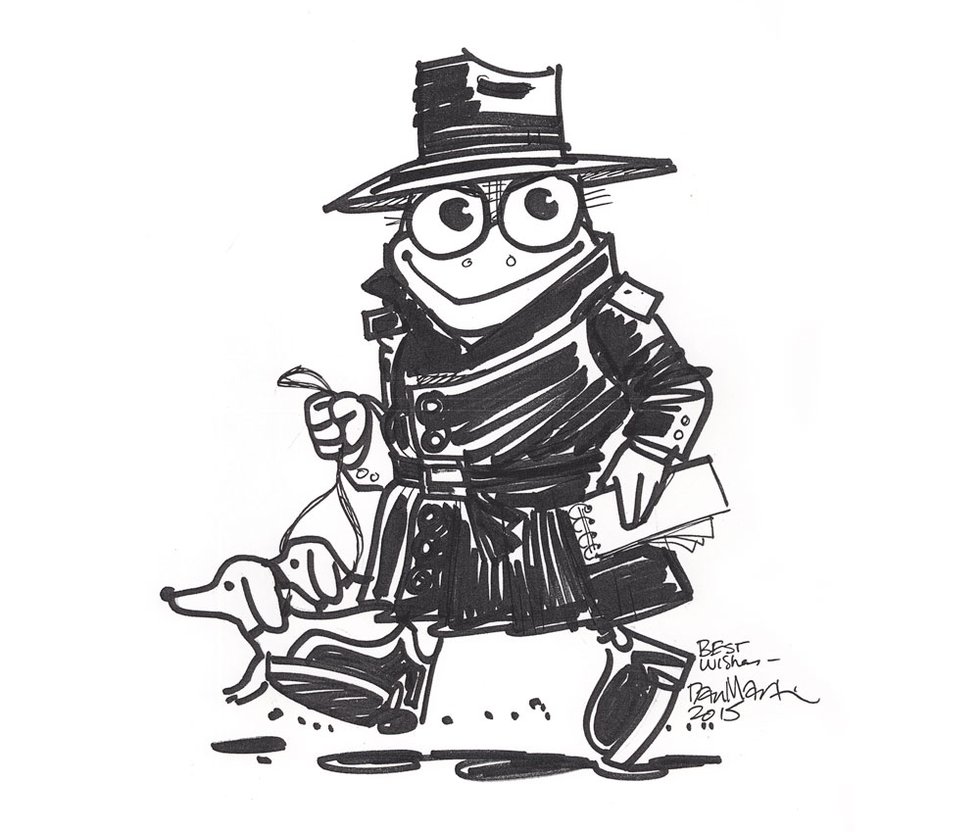
How did you stumble onto the George Peach story? It was all over town that the county cops had arrested the city circuit attorney with a prostitute—George Peach, the law-and-order guy who closed down all the sex shops. I’m working the night shift, and I see that our senior courts reporter, Bill Lhotka, has written a holding story, sourced with five anonymous sources all saying the police arrested George Peach. Of course, I thought the Post was going to run that story.
Why didn’t they? Because in their minds, five anonymous officials whom Lhotka knew to be reliable weren’t good enough. They weren’t going to run it unless McCulloch said so himself. They were afraid, the poor boys.
So what did you do? Called Ron Battelle, the county police chief, at home. All day long he had denied that Peach was arrested. I said, “I’m calling to let you know that the Post is going to run this story, and we need your explanation of why you have been denying it.” He said, “Well, we didn’t arrest him, but we did detain him, in a sting with an undercover policewoman at the airport Marriott.” We ran the story on the front page.
Then what happened? The rest of the week Lhotka and I get phone calls from real prostitutes saying, “That guy in the photo, that’s George Peach? That’s Larry Johnson! He’s been my customer for years.” Prostitutes have something in common with journalists: They’re natural gossips.
But they don’t exactly have street cred, if you’ll forgive the pun, against a popular circuit attorney. How many prostitutes do I have to line up in a row to have any credibility against the chief elected prosecutor in the city of St. Louis? I could have a line 5 miles long and we wouldn’t run it. I thought, “This is going to have to be a money story.” Here is a forty-something civil servant who’s making maybe $60K. If all these prostitutes are telling the truth—that’s a big if—where is all this money coming from? It’d have to be from his office.
How’d you get proof? Old-fashioned shoe leather. He’s a lawyer—he’s not going to turn the records over, Sunshine Law be damned. I pulled Lou Rose, the best paper-chaser we had. We thought, who else has financial records from Peach’s office? [Comptroller] Virvus Jones promised to help us and never did, so we found, literally, a little man in the basement of City Hall who had his records. We spent weeks copying all these checks. Virvus never knew.
And among all those dusty files, you found… A $2,500 check written from a bank account for confidential investigations in the circuit attorney’s office but deposited in the very personal George Peach bank account at another bank—which we identified by looking at his divorce file.
Did you confront Peach? He wouldn’t talk to us. Then, just when we are ready to push the Send button, he calls and says, “If you run that story, you will be embarrassed. I have an explanation. I won’t tell you now, but if you come by tomorrow, it’ll all become clear to you.” We couldn’t exactly run it and say, “George Peach says he has an explanation and he won’t give it to us until tomorrow.” He had us.
Did you go to his office the next day? Yes, and he opens the top part of these Dutch doors and hands me a lined yellow legal pad and it says, I used that money to pay my taxes, and then I repaid it. He offered no proof. And I thought, “This is what they call a written confession.” So I go back and put that in, and the story now says, “George Peach took…” And the force of that first story forced George Peach to let us in to look at the confidential financial records in his office.
So then you had him? He made us wait two weeks before he turned the records over, and he destroyed most of the records, but he knew he couldn’t destroy all of them. We leased a big copy machine and spent the next two weeks copying all of what was left from his records. And one day we go in and there’s a criminal file on top of the pile of financial records, and it’s the file of the shitbum who murdered Lou’s son. This was Peach’s way of saying to Lou, “I prosecuted your son’s murderer. What are you trying to do to me?” It hurt Lou. His wife wanted him to stop working on the story.
You both kept going, though. Yeah, but George Peach was so popular, such an institution, that our stories were having no effect. So one day we’re coming back from his office in the municipal courts building, and we’re passing the police headquarters downtown. I say, “Lou, let’s just go in here.” We ask for the chief of police, Clarence Harmon. He’s out of town, so we talk to the acting chief, Jim Hackett. I say, “Jim, why isn’t the police department investigating George Peach?” There’s silence for like two minutes. Finally he says, “Because nobody’s asked us to.” Clarence Harmon comes back to town, and his wife shows him our story. He says to Hackett, “I see here we are not investigating? Well, you are wrong about that. We are investigating, and you’re going to head the investigation.”
George Peach was eventually indicted. By one of his own grand juries. He pleaded guilty to four counts of felony theft, as well as official misconduct. He stole the money from the confidential investigations fund and the victims’ fund.
I’m guessing he didn’t serve time. They didn’t even process him. They had a probation officer come into the courtroom for George to sign the papers, so he didn’t spend so much as 10 minutes behind bars. Meanwhile, one of the madams who had serviced him got 10 years in prison. So if you think there isn’t justice for some and no justice for others…
At least you made it public. These were arguably the most dangerous stories the Post-Dispatch has published in modern times. We out-and-out accused the circuit attorney of stealing, on our authority, based upon our own investigation. If we had been wrong, George Peach might now own the Post-Dispatch.
You were a bulldog about the Jack-in-the-Box police shootings in 2001, too. Undercover detectives killed these two guys on the parking lot and then [St. Louis County Prosecutor Robert] McCulloch wouldn’t give out any information about who the killers were. I asked for the grand jury transcripts. Now, grand jury transcripts, as we know from the Michael Brown case, are confidential by law. So McCulloch says he’ll give me the grand jury tapes. He gets the audiotapes copied at the lowest resolution. Well, there’s a guy at the Post in I.T. who has a device at home that pumps up the voices, and he loans it to me. I spent I think four months painstakingly listening and re-listening. I also bought headphones that clamp onto your ears to keep out all noise.
Was it worth it? Bob McCulloch had maintained publicly all along that every one of these undercover detectives had testified that the car had lurched toward these two detectives who in fear of their life had to shoot. Well, guess what? Only three of the 13 detectives had testified to that—and two of the three were the two shooters. And the third didn’t say it lurched forward a few inches, he said it went feet forward. Well, guess what? The feds had determined through a neutral expert that the car could not have moved forward because it was in reverse.
Then there was “The Mayor’s Money Machine” series, which was nominated for a Pulitzer and won an Investigative Reporters and Editors Award. Lou, Bob Koenig, and I spend eight months investigating Vince Schoemehl, and we prove he’s been [giving] city contracts to people who give him political donations. It’s a quid pro quo; it’s not even illegal. But Bill Woo had just become the new editor, and he knew what we didn’t know—that Joseph Pulitzer thought Schoemehl was cute and wanted to make him the next Democratic governor. The only reason they didn’t kill the six-part series is that there was already a promo for it.
What did Schoemehl do? He sent a handwritten letter to Bill Woo asking the paper to run his unedited response at the top of the front page of the Sunday paper. I was in Woo’s office when it came, and I said, “Bill, you’re not going to do this, are you?” He wouldn’t answer me. He said, “Talk to your editor. He’ll represent your views.” So they ran the thing unedited at the top of the front page of the Sunday paper. Our stories were not just bulletproof, they were bomb proof. They were documents stories. We’d done a three-hour interview with Schoemehl—he kept saying, “Well, off the record…” and every time, I would say, “Then don’t say it. The question was on the record.” Midway through, he stopped denying it and said, “So what?”
Did your editors regret giving him the front page? They wrote 20 editors around the country, asking if they did the right thing. We said, “You will be showing us the answers, right?” and they said, “No.” Staci Kramer at the St. Louis Journalism Review got the response from Ben Bradlee of the Washington Post, and he was very clear: You betrayed your reporters.
You wrote another story, with Deb Peterson, about one of Schoemehl’s political contributors getting a no-bid contract. Our editors realized they’d be even more embarrassed if there weren’t follows on the stories they tried to kill. So we were ordered to do follows. And Schoemehl was furious again, and Bill Woo appointed a committee to investigate how the story got into the paper. Jim Millstone said, “I’m not going to be part of a kangaroo court. I will do the investigation myself.” Every day for two weeks, he met with us and went over every single word of the story. Then he wrote his findings to Lipman and Woo and said, “Everything they wrote is correct.” The mayor was so mad that when he was profiled in St. Louis Magazine, he said Michael Sorkin was “evil and demented.” The reporter called me for a response. I said, “What are you going to do, say, ‘Sorkin denied that he was evil and demented’?”
Your newspaper career started when you got a college dean fired—but you didn’t stop there. Phyllis Librach and I got University City native Andrew Chambers fired as the DEA’s most feared snitch after showing that he had lied in court testimony.
And you cleaned house at the St. Louis Special School District in the early ’80s. I was working with Cathy Vespereny and Lou Rose. We got all of the top elected and appointed officials fired at the Special School District after showing how they were milking the district’s coffers for their own benefit.
What issues did that kind of nervousness stop the Post from covering? Historically—it’s better now—they have been terrified about religion, particularly Catholicism, and terrified about race, which of course leads into education.
What’s the paper’s future? They will keep throwing people overboard. Every quarter when they don’t make their numbers, they say, “Well, how many little people do we still have left?”
They never let you go—but you did get exiled—to East St. Louis, to Edwardsville, to the obits department… There are two organizations I’ve been involved in: Investigative Reporters and Editors and the Society of Professional Obituary Writers. And I’m pretty sure that I’m the only person in history who was ever a member of both.