Portly and disheveled, Robert Lee Brown doesn’t look like the sort of guy who would be light on his feet, but apparently he is. Last month, he broke into five homes in South City in the middle of night as the homeowners slept. He pilfered wallets, money, electronics, and jewelry before sneaking out.
The 53-year-old Brown prowled around in Compton Heights, a neighborhood where both the mayor and the police chief reside, and eluded a police canine before disappearing into Shaw. His M.O. was to enter through windows, hitting spots where homes are older and often have creaky floorboards, making his apparent stealth all the more astounding. The nighttime home invasion is one that criminals tend to eschew these days on the well-founded fear of getting shot. Not Brown; in one case he stole a homeowner’s keys and used the car as his getaway vehicle. In another burglary, he stole a cellphone from a young girl’s bedroom while she slept.
Get a fresh take on the day’s top news
Subscribe to the St. Louis Daily newsletter for a smart, succinct guide to local news from award-winning journalists Sarah Fenske and Ryan Krull.
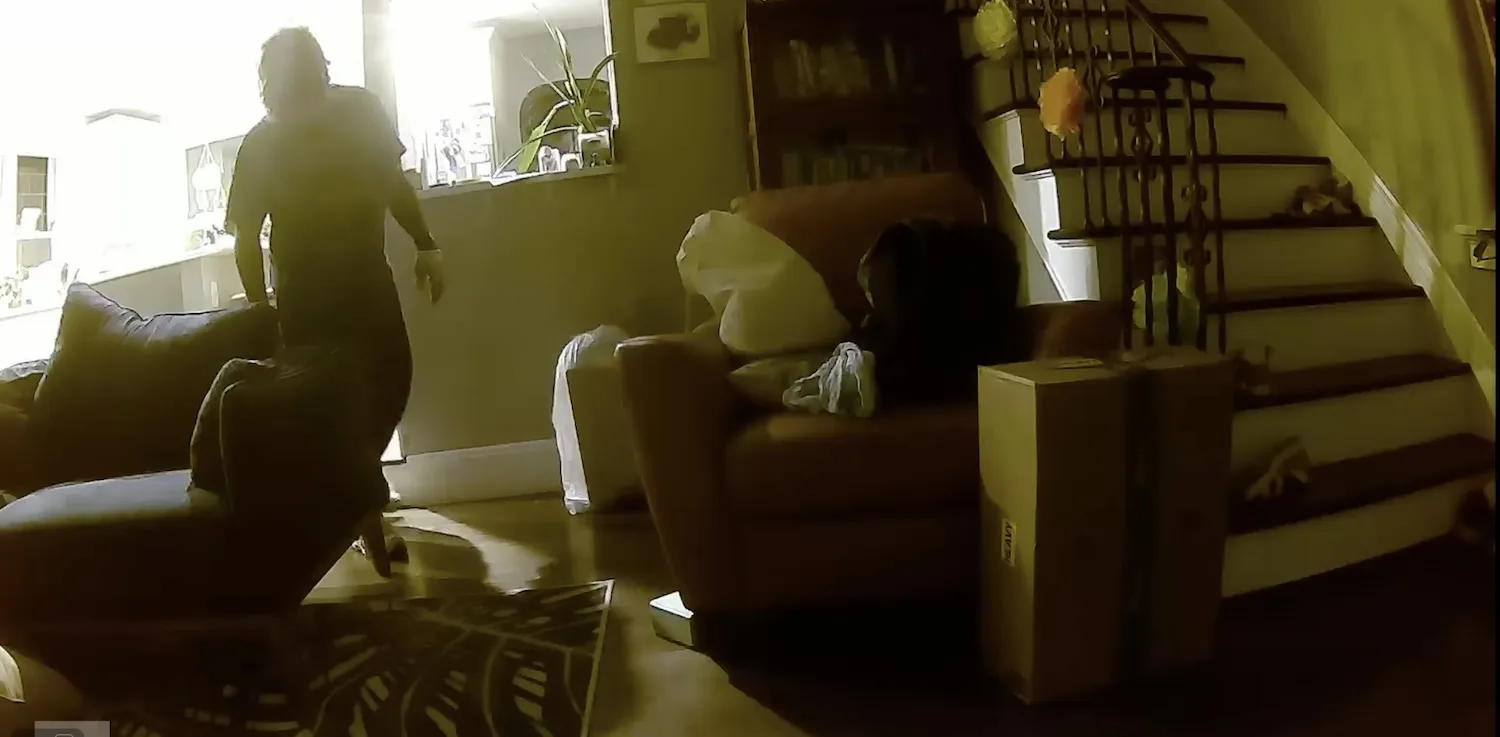
That particular burglary was captured on film. One of the family’s two dogs had taken to peeing in the middle of the night, so a camera had been set up in the living room to try to figure out which one it was. Instead, it showed Brown tip-toeing from the kitchen into the living room and up the stairs. “What are the odds that you break into the one house in Shaw that has a video camera set up to catch their dog that keeps marking the chair in their living room?” the homeowner asks.
Even worse for Brown, the homeowner tells SLM that he left behind several iPads and other tech in favor of taking a kid’s phone that was so locked down with parental controls the only thing Brown could do with it was call the police or the parents of the girl it belonged to. “He stole the most useless piece of electronics in our house,” she says. Meanwhile, the phone doubled as a tracking device. The morning after the break-in, it pinged to a homeless encampment near the Mississippi River.
The homeowner adds that she’s happy that Brown has been denied bond and is in jail, but that, at the end of the day, she mostly just feels bad for him: “Not in a pitying sort of way. It’s more I don’t feel like anything has gone right for him.”
After five days of cat burglaries, a rookie police officer spotted Brown wearing a rain poncho at an intersection in Soulard. By now, Brown’s face was all over the news. Video from the doggy spy camera and stills from myriad other security systems had made their way to the police and the media. The police had called a press conference. The hunt was on. The officer who spotted Brown said he’d prayed about trying to apprehend the cat burglar before going on duty that shift. “You have a warrant for burglary,” the officer said. “Oh, man,” replied Brown. He was charged with 14 felonies and three misdemeanors stemming from the break-ins.
Brown’s history shows a guy better at committing burglaries than getting away with them, of adroitly entering and exiting homes while leaving ample evidence for the police to use to eventually track him down. His robust record suggests less a criminal mastermind than a man who was dealt a tough hand and couldn’t figure out how to play it—with a deadly juvenile act sending him to adult prison as a teenager. He later committed a string of nighttime home burglaries in Kansas City in 2015 virtually identical to the more recent ones in St. Louis, getting collared after hitting at least three homes in two weeks in historic neighborhoods in that city’s Northeast area.
That spree started in June 2015, in Scarritt Renaissance, a neighborhood with century-old homes and proximity to an eclectic set of restaurants. A couple on Gladstone Boulevard came downstairs to find their television missing from their living room and their car missing from their driveway. Golf clubs and other electronics were gone too. Brown had come in through the kitchen window, which he’d left open, pry marks near its frame.
The following night, Brown hit a home in Pendleton Heights, one neighborhood over. The couple sleeping upstairs awoke around 4:45 a.m. to call from their home security company. They went downstairs to see their front living room window broken out, their kitchen cabinet doors open, and bottles of booze gone. The back door out onto the porch was ajar.
Out on the porch, the couple found the missing booze as well as their home stereo equipment. Brown had almost certainly been in the process of carting the goods away when the alarm interrupted him. After breaking in but before he began thieving, Brown helped himself to three Mountain Dews from the fridge, leaving the empty bottles on the kitchen counter. It was another example of Brown being good at being light on his feet but bad about leaving evidence: The police pulled DNA and fingerprints.
A little less than two weeks later, a woman in Scarritt Renaissance awoke to a rustling noise outside around 6:15 a.m. About 20 minutes later, the homeowner heard more noises and saw Brown standing in her backyard, just inside the gate of her privacy fence that opens onto her driveway. Brown apologized, saying he was a painter and at the wrong address. He began to walk away nonchalantly.
It was then that the homeowner noticed that laid out on her driveway were many of her household possessions. She ran back inside to call police and then back out to her driveway to keep eyes on Brown. He’d vanished, but a window was now open. The woman ran back inside to find Brown in her dining room. The two looked at each other before Brown darted off, grabbing the homeowner’s husband’s messenger bag. Police searched the area and spotted Brown, with the bag still in hand, and arrested him. DNA evidence connected him to the soda can, an “oily residue” in a different home’s window, and a screwdriver that had been left at a break-in the previous year.
Brown wound up serving a little over eight years in prison for the burglarlies. He was released this past January, about eight months before he commenced his most recent crime spree, which he kicked off by using garden shears to pry open the window of a home in Soulard.
That eight years in prison was not his first time behind bars. Brown spent five years in the 1990s locked up on burglary charges.
But it’s Brown’s first stint in prison that suggests the woman whose house was burgled was right, that his life has been a hard one. He turned 18 while in prison, locked up for manslaughter when he was 15.

Much about that crime isn’t public because it was committed by a juvenile. However, because Brown served time in his adulthood for it, partial records are available. In May 1989, Brown was at a family barbecue in the Walnut Park East neighborhood when an older family member named Glennell James allegedly beat him up and put a burning cigarette onto his neck. A fight ensued. The police came but were sent away by family members.
Shortly thereafter, Brown got a gun from the basement and shot and killed James. Other than being his older relative, it’s unclear who James was to Brown. He could have been his father or an uncle. Records show that Brown’s legal guardian was a woman who was not his mother.
The shooting didn’t make the daily news, though a search of newspaper records shows that on the exact same block of Wren Avenue, around the same time, a 19-year-old girl survived getting girl shot in the neck, a 17-year-old boy died after getting shot in the head, and an 11-year-old was hospitalized after drinking gasoline stored in a soda can. It was clearly a tough environment.
After shooting the relative, Brown spent two years in juvenile and at the city’s Workhouse. His juvenile public defender was, for a time, current Alderwoman Sharon Tyus. Tyus doesn’t remember Brown—she had only started in the job the month before the shooting—but says that in those days she tried to counsel the youth whose cases were assigned to her. She would tell them that she would defend them while letting them know, “What you are doing isn’t right.”
As for Brown, she says, “If I saw him now I’d be very disappointed. Breaking into people’s houses, that’s a good way to get shot.”
Brown indicated to a judge in 1991 that he didn’t have much support from his relatives. He said that the woman who owned the house where the shooting had occurred had warned him to not go to trial, where he might claim self-defense. “She told me if I take it to trial anyway, she was going to make sure that I burned for what happened at her household that day,” a 17-year-old Brown told Judge Charles D. Kitchin.
Kitchin passed away in 2021. The photo for his obituary describes him as an avid hunter and fisherman. The accompanying photo features him chomping a cigar.
During plea hearings, judges are not supposed to put their fingers on the scale to influence a defendant’s decision. But Kitchin obviously agreed with the public defender that it wasn’t worth it for Brown, who was a few months shy of his 18th birthday, to risk pressing his innocence at trial. A jury trial could, in theory, result in as high as a 30-year sentence.
The plan was for Brown to enter an Alford plea to involuntary manslaughter—not admitting he did the crime, but conceding the state had ample evidence to win at trial. The state would drop an accompanying armed criminal action charge and Brown would be sentenced to five years.
Given the “crowded conditions” in the Missouri Department of Corrections, Kitchin’s guessed that Brown would only do about one-third of that sentence, which was only slightly more than what he’d already done in juvie and at the Workhouse. This is sometimes called an “in and out”: After getting credit for time served, Brown was being given a sentence he had essentially already finished.
“You’re not going to do much more time after they compute this under that set of mathematics,” Kitchin said.
It was undoubtedly the right call. But for Brown, for hardly the last time, things did not go as planned. He was booked into the state prison system the following month and would stay there for longer than the next two years. He left just shy of turning 20, having been locked up in one place or another since he was 15.
More than three decades later, he’s facing a slew of charges for burglary, attempted burglary, property damage and stealing. His most recent crime spree spanned four nights and eight different homes.
Asked what kind of prison time Brown is facing, noted criminal defense attorney Terry Niehoff says he’d hazard a guess of “10 years, plus or minus a couple.”
Niehoff stressed that this is all highly dependent on who his attorney is, who the prosecutor is, and who the judge is. But whatever Brown’s sentence is, because of his previous time in prison, he’ll have to serve at least 80 percent of it.