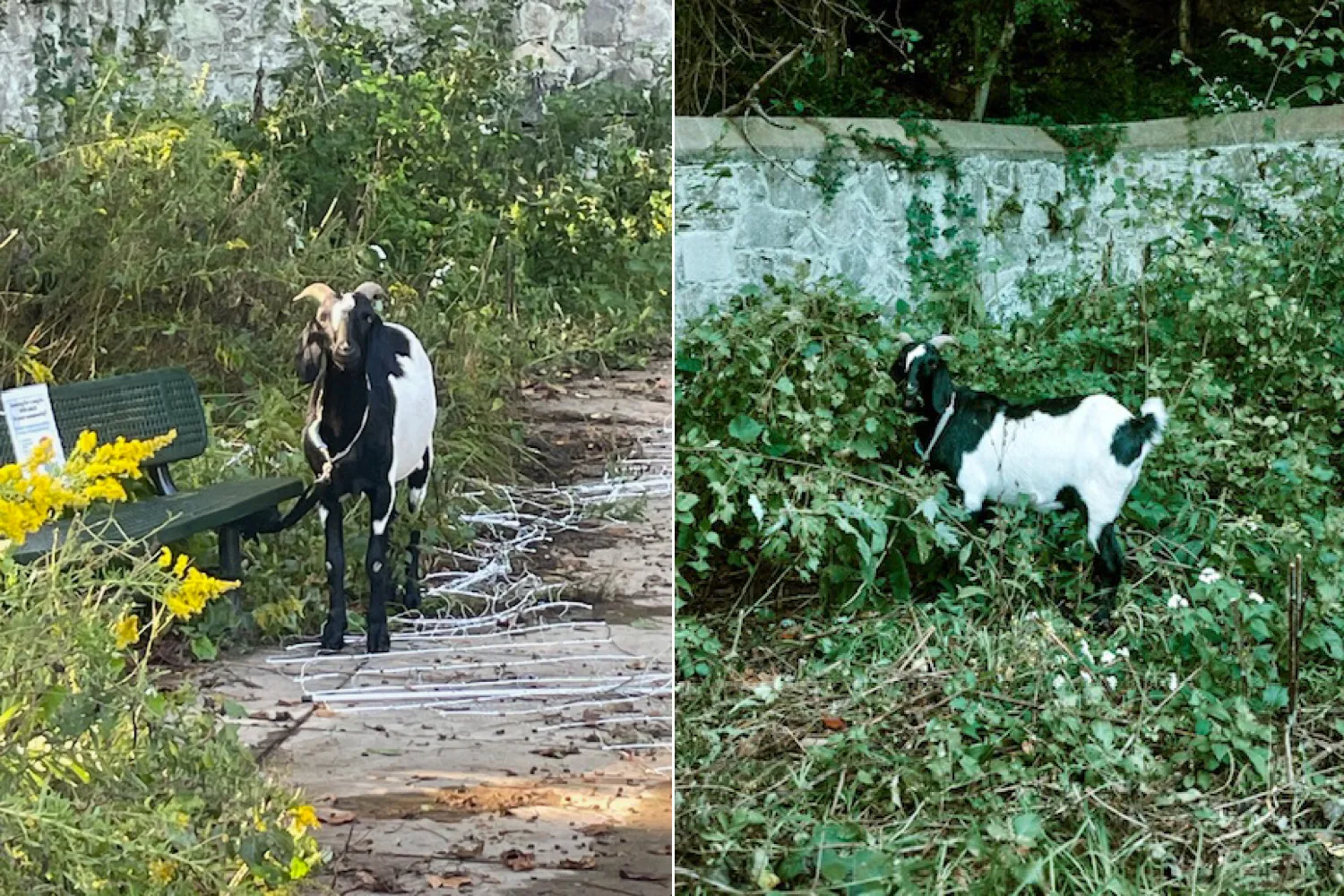
Carondelet Park has hired the GOAT to do some grass-cutting—actually, make that goats. A crew of seven goats clocked in at the park late last week after the Friends of Carondelet Park hired them via the local outfit Just Us Goats.
Alderwoman Anne Schweitzer, a member of the Friends of Carondelet Park board of directors, says a roughly acre-wide bird habitat had become overgrown. A generous donation from state Rep. Steve Butz and his wife, Angie, allowed them to hire the hoofed helpers to clear it. “We’ve worked with the city to get all the right people to sign off so that the goats are safe and happy in the park doing what they love most, which is eating,” Schweitzer reports.
Get a fresh take on the day’s top news
Subscribe to the St. Louis Daily newsletter for a smart, succinct guide to local news from award-winning journalists Sarah Fenske and Ryan Krull.
She says the goats cost roughly the amount of a human crew, but they’re more environmentally friendly—less likely to cause soil compaction, and powered by plants. Plus, they’re darn cute.
The initiative is part of the all-volunteer park board ramping up its efforts to aid what is the city’s third largest park; the top two, Forest Park and Tower Grove Park, both have paid staff thanks to the sizable nonprofits that operate them. Carondelet’s 20-year old nonprofit has significantly fewer resources, but is amping up its efforts. This year, it will host its inaugural fall festival on Oct. 5. It’s celebrating the creation of the city’s first mountain-biking trail, also the work of volunteers.
“We’re just trying to be as forward-thinking as we can about how to make this park even better, an asset for the community and a destination in South City and the region,” says Schweitzer.
The fact that so many city parks need separate structures to support and maintain them is an unfortunate fact that isn’t lost on Schweitzer. That’s what happens, she says, when a city built for 800,000 people ends up with just 300,000 residents.
“We have to be a city of volunteers, otherwise we wouldn’t be able to keep running,” she says. “The fact that we’re doing so much invasive plant management and planting and the work on the bird habitat is all done by a group of volunteers—it’s the kind of the stuff that you would hope the city would do, but at the same time, the city can’t. They just can’t. That’s where the nonprofits and the volunteers come in.”
And at least these new landscapers have proven easy to manage.
Says Schweitzer, “These goats are hard workers. They’re not going to stop until the job is done.”