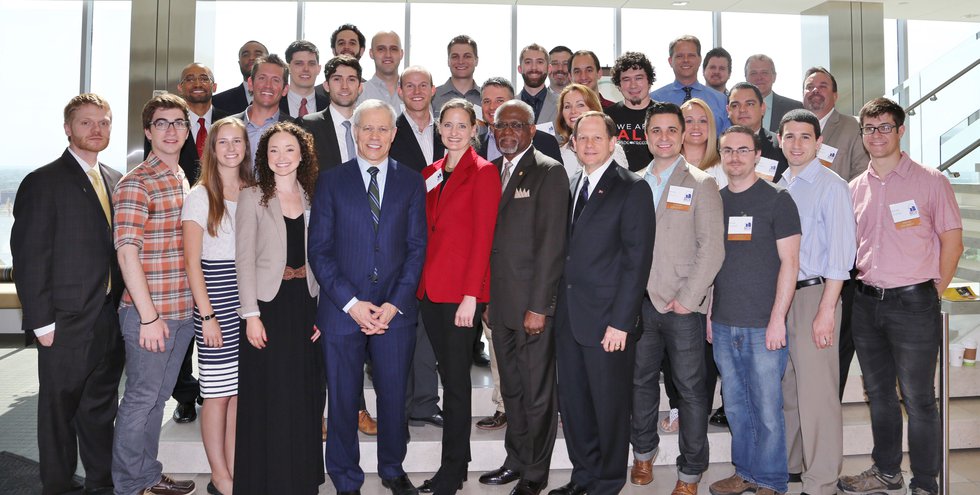
This morning, Arch Grants announced the winners of its third annual startup competition, at a swanky event in a downtown office tower overlooking the organization’s namesake landmark. Each of 20 recipients will receive $50,000. The nonprofit takes no equity in the companies and only requires that they move to or stay in St. Louis for one year. (For a complete list of the winning businesses, skip to the end of this post.)
Eleven of this year’s winners are from outside the state, with three international companies in the mix. Jerry Schlichter, Arch Grants co-founder and president of its board, described how the program is able to attract businesses from all over the world in an interview that I did for SLM‘s June issue. Startups are given a range of free support services, including business mentoring, legal, marketing, and cloud computing. St. Louis is a much more affordable environment for a fledgling company, with its cheap residential and commercial real estate, than New York or San Francisco. And the startup scene here is more supportive and collegial, less cutthroat.
Get a fresh take on the day’s top news
Subscribe to the St. Louis Daily newsletter for a smart, succinct guide to local news from award-winning journalists Sarah Fenske and Ryan Krull.
“One of the critical components of success as a startup business is having access to others who are also in the space, because they can share information, share ideas, sometimes share technology, and not feel that they have to invent the wheel themselves,” Schlichter told me.
But perhaps the biggest factor of all is that, unlike the vast majority of funding competitions across the country, Arch Grants doesn’t take equity in the companies. Why not? “To make this opportunity in St. Louis more attractive, and to make the companies themselves more attractive to follow-on investors, because they would have 100 percent of their companies retained and have more flexibility,” Schlichter says.
Unlike venture capitalists who are out to make money, Arch Grants is a nonprofit, striving to improve the region by attracting talent. “Arch Grants is a different approach to philanthropy and economic development,” Arch Grants executive director Ginger Imster said at Wednesday’s announcement. “Our innovation is how we leverage philanthropic dollars to encourage for-profit development in St. Louis. That innovation matters, because in order for a community to thrive, it always has to be creating new jobs in new industries to retain and attract the most talented people.”
Given the civic-boosting tone of the Arch Grants mission, it’s probably no surprise that Mayor Francis Slay and County Executive Charlie Dooley were on hand Wednesday to sing the program’s praises. They each mentioned our place on The Map.
“This is a program that really has helped put St. Louis on the map as an innovation hub,” Slay said. Dooley chimed in: “This has put the St. Louis metropolitan area on the map. We are a place of innovation and a place of destination. People want to be here, creating jobs and opportunity.”
There’s a certain segment of old-school St. Louis that enjoys poking fun at hipsters. Dooley made a crack about recognizing the entrepreneurs in the crowd because they weren’t wearing ties. Sure enough, a few of the past and present winners in attendance were twenty-something men in skinny jeans, flannel shirts, and vintage glasses. But there were also guys in suits and middle-aged women. Some companies are hip tech concepts, but others have more conventional business models.
The only common thread was this: They all have good ideas. “In the global economy in which we compete, good ideas and innovation, usable technology, those things are going to win out,” Schlichter says. “Because Arch Grants is a global competition, we can get great ideas from all over the country and outside the country.”
Richmond Heights resident Dawn Manske founded Made for Freedom, a clothing company aimed at employing victims of sex trafficking. Hyde, a company from Milwaukee, makes the Wingman, “a first-of-its-kind life vest allowing swimmers to rescue themselves.” Blue Line Security, started by current and former St. Louis police officers, uses facial-recognition software to help secure businesses.
These 20 winners join 35 from the past two years. Of those previous recipients, 32 are still operating, and 31 are still in St. Louis. According to numbers provided by Arch Grants, they’ve created nearly 200 jobs, generated more than $6 million in revenue, and attracted nearly $18 million in follow-on funding.
“Hopefully, we’ll create the next Express Scripts or the next Enterprise or the next Emerson,” Schlichter told me, “which may sound grandiose, but you’ve got to try.”
***
Here is the full list of winners, with the descriptions provided at the announcement. Some of the concepts are more intuitive than others.
Artifox,St. Louis: A furniture company devoted to merging quality craftsmanship with the constantly changing needs of the modern mobile professional.
BetaVersity, St. Louis: Promotes the maker movement by offering its BetaBox, a custom prototyping pod built inside of a shipping container.
Blue Line Security Solutions, St. Louis: Offers an affordable, practical, and reliable facial recognition system that can help protect stores, schools, offices, and entertainment venues from unwanted visitors and threats.
Cast, St. Louis: A dedicated mobile app that allows publishers and consumers to quickly understand social opinion by creating public or private polls and observing structured response data in real time.
CoMo Medical, Columbia, Mo.: A medical device and pharmaceutical startup offering solutions to unmet needs in healthcare.
Dabble, San Francisco: Provides subscribers an easy way to teach or take specialty classes on a wide range of subjects.
Ephecom, Boston: An e-commerce marketplace that gives the end-user two things: steep discounts on the products they love and 60 seconds to decide whether to buy or pass.
FreightGrid, St. Louis: A Web application that manages the entire less-than-truckload shipping process, saving time and money for customers.
Greetabl, St. Louis: The fun and memorable way to connect with important people by sharing thoughtful gifts with a personal note.
Hyde, Milwaukee: Manufactures the sporting equipment of the future, starting with the Wingman, a first of its kind life vest allowing swimmers to rescue themselves.
Jolt, Boston: Makes wearable head impact sensors for youth athletes to help detect and manage concussions.
Less Annoying CRM, San Francisco: Makes a smile customer relationship manager for small businesses.
LIFEPACK, Cali, Colombia: Produces and sells plates made of natural fibers (pineapple crown) and seeds that can germinate into a plant.
Made for Freedom, St. Louis: Driving a social entrepreneurial mission to establish a global, online, retail/wholesale clothing business while providing dignified employment for survivors of sex trafficking.
MeterGenius, Chicago: A free website that provides tools and incentives for homeowners to save money on their electric bill.
Nanopore Diagnostics, St. Louis: Enables physicians to make informed antibiotic decisions during their initial examination of a patient.
Prattle Analytics, Boston: Utilizes proprietary textual analysis methods to provide innovative financial data solutions.
Tallyfy, London, England: Makes critical business processes incredibly user-friendly and visibile—in real time with a friendly layer on top of complex tools and confusing processes.
Tuloko, Minneapolis: A social enterprise focused on driving more business to minority- and women-owned businesses.
Wondermento, London, England: A digital company building apps that interact with lovingly made connected devices to create happier and healthier living for all.