Newspapers across the U.S. exploded in jubilation on August 31, 1904: An American won the Olympic Marathon!
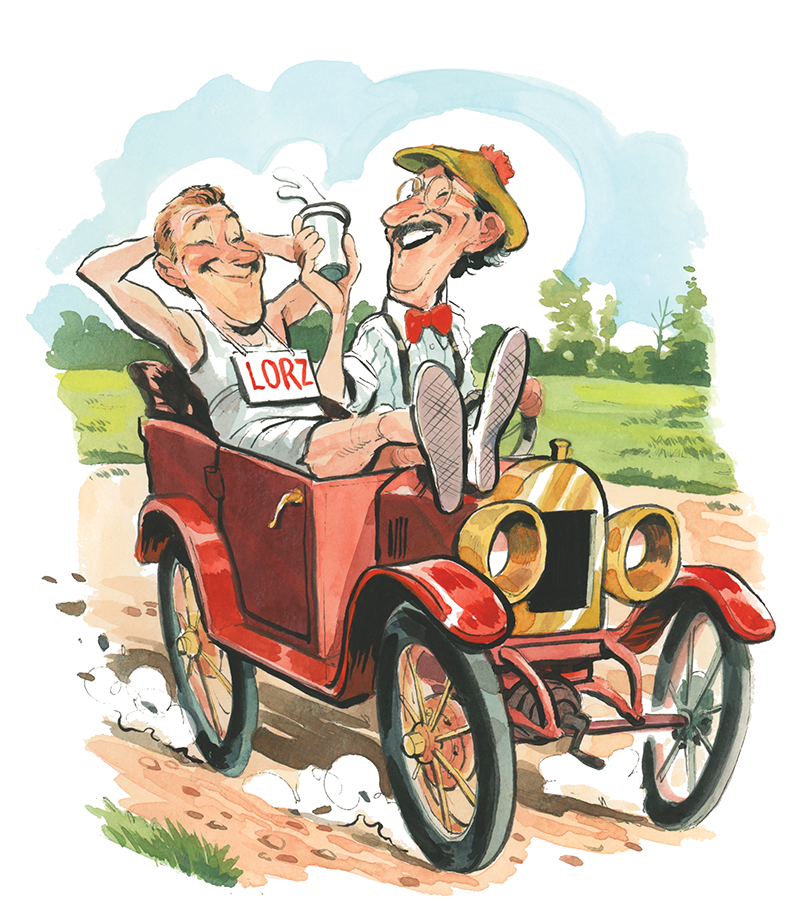
Putting a damper on all this effervescing was the embarrassing admission that Fred Lorz allowed a laurel crown to be placed upon his unworthy head. He’d smiled and shared a photo op with Alice Roosevelt, daughter of the president, but just as she was looping the gold medal around his neck, he was outed as having cheated. “Fred Lorg [sic] of New York City was the first to cross the goal line but he was immediately disqualified on the charge he had ridden about three miles in an automobile traversing the course over country roads,” reported the Louisville Courier-Journal. “Lorg readily admitted that he had done so because of physical exhaustion for a time.”
In fact, all of the runners struggled to finish the marathon, including experienced athletes like the legitimate first-place winner, Thomas Hicks. The 24.85-mile race began on the stadium track, then left the fairgrounds and wended its way through Clayton. “The course led over hills and through dales innumerable, being pronounced one of the most uphill and downhill courses ever traveled,” the Courier reported. The temperature was about 92 degrees, which, of course, felt much warmer and stickier because, well, St. Louis. Runners only got a chance to take a drink at the 6- and 12-mile marks.
Only 14 runners actually finished the race. William Garcia of San Francisco collapsed on the side of the road several miles from the fairgrounds. Lorz petered out long before the second water station, overcome by cramps at mile 9. His manager gave him a lift for the next 11 miles, and Lorz waved at cheering audiences as he zoomed past the halfway point. Around five miles from the finish line, Lorz hit the course again on foot, only to be spotted by one of Hicks’ indignant coaches. As Lorz entered the stadium, the crowd exploded with applause. That elation soon became a chorus of boos, however, after Lorz’s car-ride shenanigans were revealed. He sheepishly told the crowd it was true—but, er, it was just a prank?
Lorz’s antics embarrassed the Olympic committee and the Amateur Athletic Union. The next year, however, both Lorz and Hicks competed in the Boston Marathon, and Lorz won—fair and square. During the last stretch, he dusted his competitors while running up a hill and approached the finish line to a continuous thunder of applause. “Frederick Lorz, the Mohawk Athletic Club man, ran first after the pluckiest kind of a race in 2 hours 38 minutes and 23 2-5 seconds,” The New York Times wrote. “It was a notable victory.”
Born to Run
During the day, Fred Lorz worked as a bricklayer. He trained at night. The sheer number of races he ran shows his love and dedication to his sport, even though his fame is a silly footnote in the early history of the Olympics. He ran races before 1904 and afterward. “Fred Lorz … led in the weekly practice cross-country run of his club over the Bronx highways yesterday afternoon, covering the course of about four and a half miles in 25:40,” The New York Times reported in October 1904. The paper also noted Lorz’s first-place finish in the 1908 Mott Haven Athletic Club race, “a long, weary journey of six miles” in “cold, driving rain, with roads at places ankle deep in mud.” Perhaps it was running in the cold and rain that contributed to Lorz’s early death from pneumonia at age 29. Lorz passed his love of running to his children, too: In 1930, The New York Times noted another race won by a member of New York City’s Mohawk Athletic Club, Fred Lorz Jr.