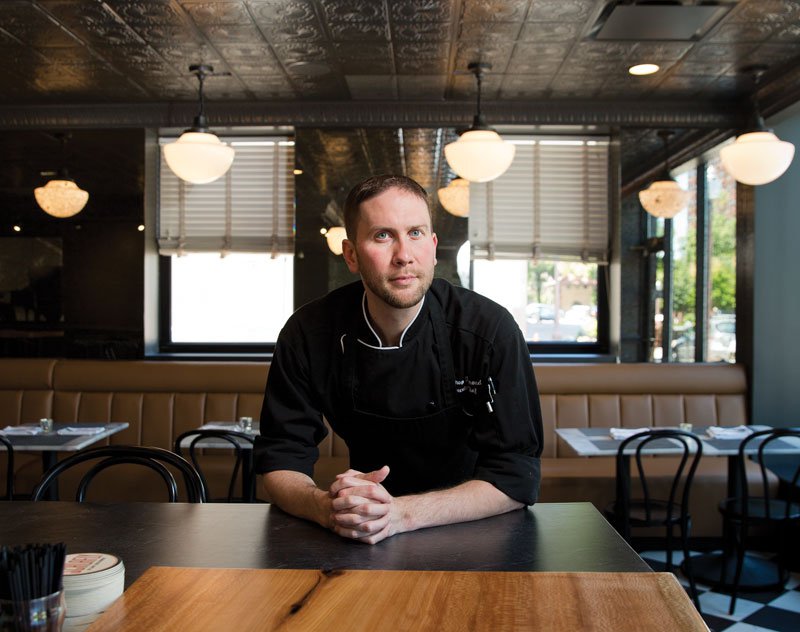
Many of today’s chefs face a difficult decision: whether to serve familiar dishes (which many avant-garde chefs don’t want to cook) or more artistic dishes (which many customers don’t want to eat). Shimon Diamond, the former chef de cuisine at Cielo, understands the dilemma—and believes that he has a solution.
What’s the most important lesson you’ve learned as a chef? The balance between having to be a disciplinarian and respecting your workers. It took me years to discover you get the most out of people through mutual respect.
Find the best food in St. Louis
Subscribe to the St. Louis Dining In and Dining Out newsletters to stay up-to-date on the local restaurant and culinary scene.
Has becoming a chef become easier or harder? Harder, because the public’s expectations are higher due to what they see in the media. Heck, kids are cooking great meals on TV now, so if the adult chefs don’t step it up, they only have further to fall.
Is becoming a chef a more desirable career or less? Much more desirable because of all the potential glamour. That element didn’t exist when a chef was considered a blue-collar worker.
The work hasn’t gotten any easier, though. Not at all. When I was at Brasserie, as the lead line cook, we used to sing a Willie Nelson song, twisting the words, “Mama don’t let your sons grow up to be line cooks…” We’d get our butts kicked regularly—it was like, “Why did we choose to do this again?”
How briefly can you detail your resume? The last few stops include a year at Sidney Street Café; kitchen manager at Square One Brewery; three years at Westwood Country Club; a stint at Monarch; then Brasserie by Niche, Cielo, and Scape.
Where did you learn the most? Fundamentally, from John Bogacki at Westwood, working hot food competitions for the ACF [American Culinary Foundation] team. I learned professionalism from Michael Petres [then executive chef at Brasserie] and how to make great food from Gerard [Craft]. They never let up… They took me to the next level.
Where did you have the most fun? Cielo. Not that we cracked jokes all the time, but having all those different venues—the terrace, the chef’s table, the wine room, working off campus—it was always different. Chef Gianni and I had a blast.
What’s the differences between working at a hotel restaurant and an independent establishment? The first has structure—a lot of different managers and a team approach—and the latter is more about your voice—even if it’s stifled a little bit. [Laughs.] You don’t have a corporation saying, “No, Shimon. This is the way it is.”
Any regrets? One was not staying longer with Kevin [Nashan] at Sidney Street. He was starting to do something important; look at all the Beard nominations he’s received because of it. When I was garde manger there, I remember this guy would come in the back door pretty regularly, needing to borrow produce, stuff that he knew we probably had, and I was like, “This guy again?” Little did I know it was Gerard Craft, who, by the way, was starting to do important things himself.
Scape is almost nine years old. How has it evolved? It started as a fine-dining restaurant and morphed into more of a bistro. The ideal niche is “fine-dining bistro.” It sounds a bit contradictory. Call it “comfort meets elegance”—doing rustic dishes with panache and more aesthetic appeal.
Explain how that happens. Filet mignon has a high perceived value, for instance. Our challenge is to create the same elevated value for something like gnocchi or a less common fish like triggerfish. For example, we elevate sashimi-grade, big eye tuna—a common but popular fish everywhere—by shaving some bottarga [cured and pressed fish roe] on top which makes it special.
Is the price point less? We have plenty of affordable dishes that show the value of what we do, but we have several let’s-go-big dishes as well, like a filet that’s in the mid $40s. Once you hit $30-plus per entrée, you’ve crossed the bistro line. That’s why “fine dining bistro” is apropos.
How much customer education is there at Scape? It’s an obligation of restaurants like ours to talk about items we’re proud of, because some have never been offered before. St. Louis’ dining scene is evolving, and it’s up to us to evolve with it.
Do you segregate items on the menu, so diners can see where you’re going with this? No, they’re all integrated. We want all of the dishes to resonate and develop a relationship, whether new or old. So even if we serve a hamburger—which we do—it’s not a low-brow affair at all. Our goal is to create food that we like to prepare that still provides happiness for the guests. It’s balance and compromise. We see it as a journey, and we’re taking everybody along.
What’s the ratio of traditional items versus chef-driven? It’s 60/40 traditional, but all the specials are created by the chef team, so it’s more like 50/50.
What’s an example of a Shimon Diamond-inspired dish? For the fish and chips, we first cut monk fish into medallions and brine them. Then we use a special batter that creates a barrier between the fish and breading, so it’s super crispy. This season, the Missouri rack of lamb dish comes with a summery tabbouleh made from faro. It never fails to get an “Oh, wow.”
What’s the most popular traditional dish? The macadamia nut chicken. But now we’re brining it, we’re pounding it out so it cooks evenly, and we’ve reduced the portion size so it’s manageable and affordable. We refined it… It’s also being featured as a slider at Scapegoat.
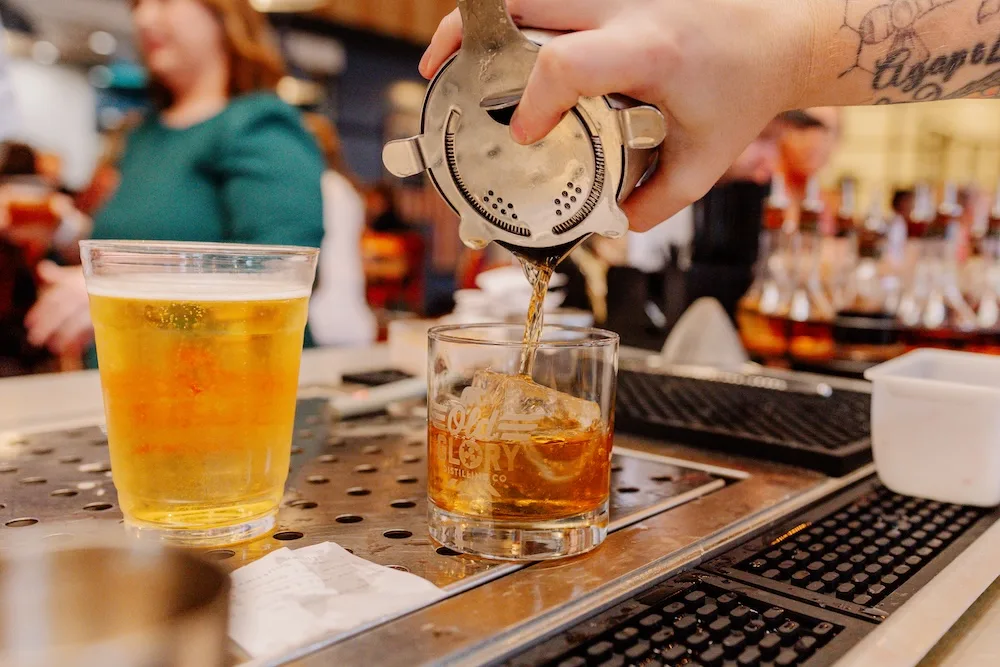
How did Scapegoat come about? We wanted to tie the two restaurants together. When it was Crêpes Etc., there was no crossover, no indication it was even owned by the same [Koplar] group. Plus, Scape’s bar was small and can get busy before and after dinner. Scapegoat solved all those problems. The name is tongue-in-cheek, almost a self-mockery. Besides the literal meaning, “goat” to us stands for the “greatest of all time,” referring mainly to the cocktails. Whiskeys, gins, and rums form the backbone, but there’s also a handful that represent famous scapegoats in history: the Monica, Yoko Ono, Buckner, Pandora, The Juice, Hester Prynne, and so on.
So is Scapegoat more bar-focused than Scape? Yes, Scapegoat was designed so the food complements the drinks; at Scape, the drinks complement the food.
What’s on Scapegoat’s food menu? We french our Buffalo drummies, so you don’t get saucy fingers eating them. A classic Cobb salad is served in a mixing bowl. There are avocado eggrolls, street tacos… It’s all fun.
What about the wine menu? There are 16 glass wines available and at least that many beers.
How will the two restaurants work together? Besides some food crossover, both have back doors that lead to the courtyard. Because of proximity, the soft seating and courtyard bar is considered part of Scapegoat, and the dinner tables are part of Scape.
Are there plans to enclose the courtyard patio to extend the outdoor season? Nothing firm yet, but there is something in the works. It’s too big an asset not to maximize.