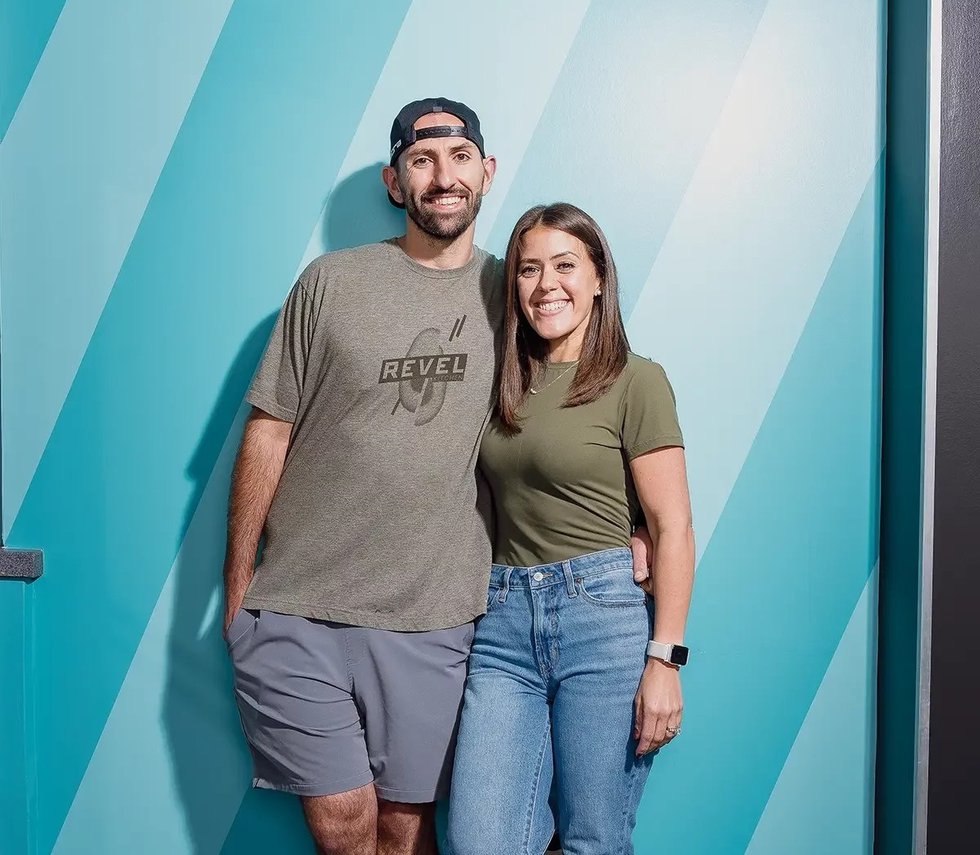
When Simon Lusky accepted an internship with the St. Louis Cardinals as a young culinary student, he never imagined that it would set in motion a chain of events that would lead him and his wife, Angelica, into the restaurant business. Now, roughly 15 years later, the Luskys lead a growing restaurant brand that includes three area locations of the health-focused Revel Kitchen, one in Boca Raton, Florida, and Motor Town Pizza, which opened in Richmond Heights in February. Their food has garnered a loyal following—including many professional athletes from the area and beyond—but if you ask the Luskys, the main ingredient in their success has nothing to do with the food.
“No. 1 is hospitality; we try to get that right before we even get to the food,” says Simon. “You have to be understanding, thoughtful, kind, thankful, humble—all those things. I think that goes for anything, even outside of food and beverage. Whatever your product is after, whether it’s a dish, beer, or a sweater, it makes it that much better if you can do something good for someone.”
Find the best food in St. Louis
Subscribe to the St. Louis Dining In and Dining Out newsletters to stay up-to-date on the local restaurant and culinary scene.
You’re now a husband-and-wife culinary force in the St. Louis restaurant scene and beyond. How did you get into food in the first place?
SL: Food has always been a part of my life. My dad had a catering company, and since I could remember I was always trying to help—as soon as I could reach the cutting board. On my mom’s side, food was everything, and I appreciated that everyone could cook. There was always someone cooking homemade meals, making things and doing it the right way. I knew since junior high that was the route I wanted to take, so I started vocational school in high school for culinary.
And that path led you not only to cooking, but to each other.
AL: Yes. We met at Johnson & Wales [in Rhode Island]. I was in the hospitality school for restaurant and hotel management, and Simon was in the culinary and nutrition program. We were both in the industry working as servers and pursuing the same career path. It just worked.
How did you get into sports nutrition?
SL: I’ve always played sports—football and hockey—and was always super into athletics. In culinary school, I saw that nutrition could intertwine with sports, so just after my sophomore year, I diverted all of my attention to networking and meeting people in that world. I got really lucky because the Cardinals were working with a guy who came to speak at Johnson & Wales. I told him I would do anything for free and ended up getting an internship with them during spring training. We drove straight from Rhode Island to Florida, did the internship in Jupiter, and then they asked me to stay for the entire season as an extended internship.
Simon, you went from being the team’s chef to working privately for several athletes as well. How did that happen?
SL: Since I was right out of college, I started making meals for guys in the off season to make money, just cooking out of our house. From the very beginning, I had an understanding that players want three main components for their meals: lean protein, clean carbs, and green vegetables. “Lean, clean, and green” is how to best describe it.
AL: Then, through the Cardinals, we met a former Blues player and started doing meals for him. That got us into doing all of the Blues catering, which we still do. Between the Cardinals, Blues, and everything else, it just snowballed.
SL: At one point, we were catering for the Blues and doing meal prep for Cardinals and Rams players out of our house while still doing the full-time gig for the Cardinals.
Is that what led to your first restaurant, Athlete Eats?
SL: It is. We had just moved to Jefferson and Russell [in South City], and we were bursting at the seams cooking out of our house. It was getting to be too much, so we started renting kitchen space but realized we needed to find our own. Cherokee was close to where we were living and super affordable. We weren’t looking for restaurant space—just a kitchen—but we found one cheap that had both a kitchen and storefront. It was stocked and ready to go, and we figured that Cherokee was a happening place, and we could turn the other side into a restaurant. We already had the people and the product, so it just made sense.
When did you realize that the restaurant side was the path you wanted to pursue?
SL: We were still doing work for the Cardinals, and slowly but surely the meal side of the business started to grow. But then it got to the point where it wasn’t growing so much, but the restaurant side really was.
AL: And logistically, the meal-prep business was a nightmare.
SL: It was a really hard business, and we fell out of love with that idea, but we really liked the restaurant side of things. We were getting good attention for it and getting busier with the store and our catering business. Ultimately, we figured we should probably put this concept somewhere in a different part of town that would be busier. We were looking around Clayton one day and didn’t find anything, so we decided to eat at Mai Lee; while we were waiting outside for a table, we saw a space right by a gym that just opened up. Really, the space found us—we didn’t find it. At that point, we realized that if we were going to do the restaurant, we needed new branding. With the help of Atomic Dust, we came up with the name Revel Kitchen. It just brought a totally different feel to the business, but at the core it was the same idea of what we’d been doing.
You were well-prepared for the pandemic. How did that impact the business?
AL: When [the pandemic] hit, we already had an app and were on third-party platforms, so we didn’t have to figure out things on the fly. We really had our systems in place, so we didn’t have to close for that long.
How did Motor Town Pizza come about?
SL: About seven or eight months into the pandemic, this ghost kitchen thing came up, which was great, because we were searching for something to add to our business. We were busy for lunch and good for dinner, but Friday and Saturday were always our slowest nights. We asked ourselves what we could do with what we already had—something that delivers and carries out well and is made in our ovens. We kept coming back to pizza, so we started researching what kind of pizza we could do in a regular oven and settled on pan pizza. We’re not from Detroit and really knew nothing about it, but we started making every single recipe under the sun until we found something we really liked. I remember the first weekend we made 50 things of dough and figured that if we sold them over the weekend, it would be a nice little addition. We sold out in the first hour. I remember telling Angelica, “Holy crap! Turn off the ordering system!” It was just this whole mindset of using part of the restaurant when it wasn’t otherwise busy, using equipment we already had, creating jobs, creating revenue, and creating opportunities for people who maybe never thought about eating at Revel. We were just testing a new theory of ways to do stuff, which was really fun.
Motortown now has a successful storefront, you have three locations of Revel Kitchen, including a new one in Maplewood that has the brand’s first drive-thru, and Simon still cooks for professional athletes. How do you do it all?
SL: I have to travel a lot, but when I’m home, we have to make the most of that time. It’s always a balancing act, but it’s been fun, and we have been lucky that people like what we’ve done and appreciate the care we put into it. We’ve been overwhelmed with how well Motortown has done in its brick-and-mortar; it’s been beyond expectations, and we know the new Maplewood store is going to do well, too.
AL: We’ve opened three businesses in less than six months, and I joke that we have to stop. But seriously, we are just excited to enjoy each one, dial things in, nurture each location, and really thrive. We have really awesome employees, and we couldn’t do it without them.
What is the key to your success?
AL: Simon does a good job of making any type of food he makes feel like comfort food. Whether that’s Puerto Rican food that he learned to make from my family or anything else, you feel good about it. That’s just something he’s always been able to do with food.
SL: I think a lot of what I like to make are things that are comforting to me. Learning about Puerto Rican dishes from Angelica’s family and learning other things from people along the way—whether that’s through traveling or sitting down to meals with other families—those are the experiences that I want to re-create. The things that make you feel something. That’s what gets me excited.