Budding Buisness
Three new St. Louis Spots where you can sip a Budweiser
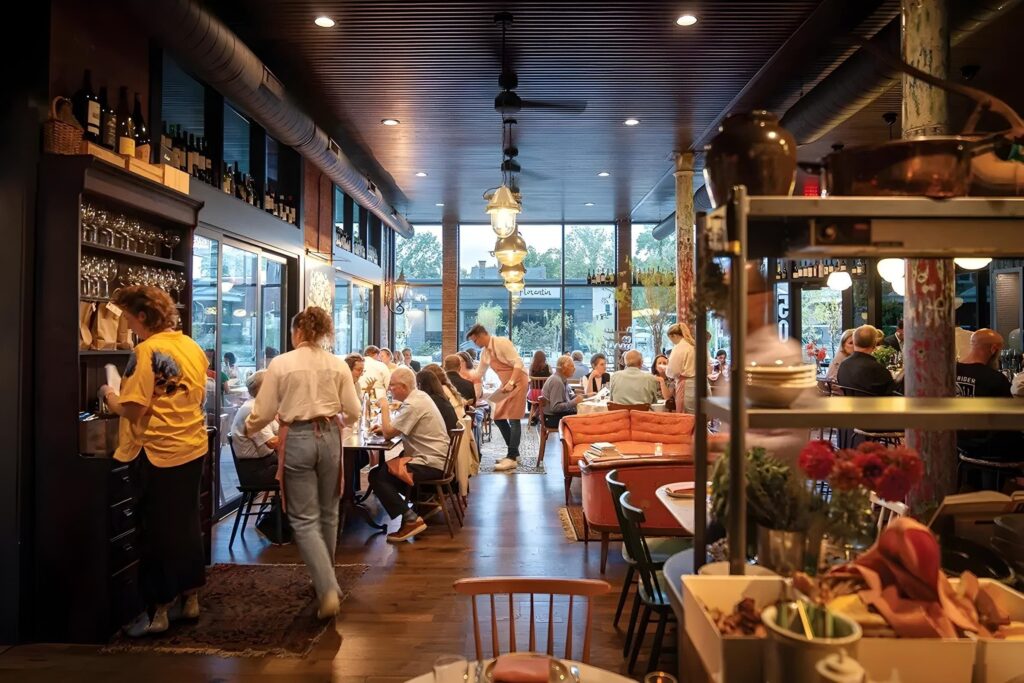
Anheuser-Busch InBev has expanded its presence in St. Louis in some major ways over the past year, with none being more visible than Budweiser Brew House (601 Clark, 314-241-5575, stlballparkvillage.com), the three-level watering hole at Ballpark Village.
Find the best food in St. Louis
Subscribe to the St. Louis Dining In and Dining Out newsletters to stay up-to-date on the local restaurant and culinary scene.
The Brew House’s circular first-floor bar is surrounded by brickwork reminiscent of the brewery, with arched entryways echoing the Clydesdale stables. A two-story, backlit mosaic is made from 1,200 bottles, and an interactive tap wall allows guests to pour their own beers. Eleven bars boast a total of 239 taps, while the restaurant menu offers items like lobster béarnaise fries. The second floor includes a VIP room, a DJ, and pool tables. And on the third floor, the deck lets baseball fans sit at tables and sofas, order food and beer, and enjoy a prime view of center field. (If you’re going to Budweiser Brew House after 9 p.m., though, remember the dress code—you know, the one you heard about when Ballpark Village opened this spring.)
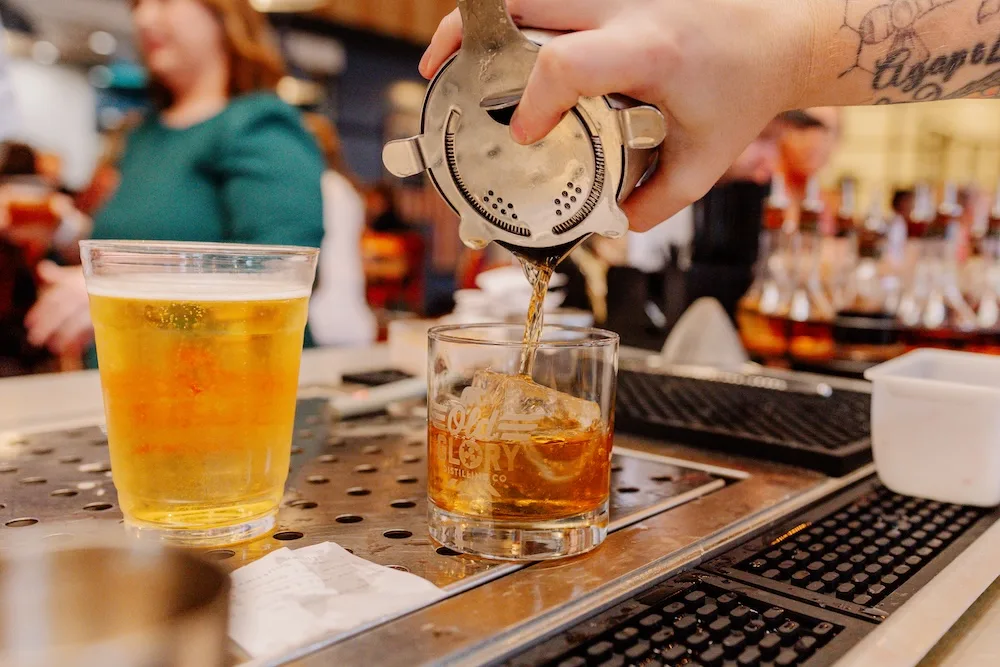
Just down Broadway, the original Anheuser-Busch destination offers another spot to sip a brew. Located just outside the brewery’s Tour Center, The Biergarten (12th and Lynch streets, 314-577-2626, budweisertours.com) opened last year, but recent changes have made it an indoor-outdoor space. It has an open-air cooking station for talks on beer-and-food pairings, 17 beers on tap, a beechwood bar (the same wood used to make some A-B InBev products), and draft Budweiser poured from a tap that cools the beer and finishes the pour with a head of insulating micro bubbles that is much creamier than a traditional head. Every day at 3 p.m., a brewmaster leads a tasting, and afterward guests can pose with a Clydesdale.
One more way that St. Louisans can grab a Bud: the Budweiser Brewmaster Tour, with an A-B InBev truck that parks and offers simulated beer-brewing demos and samples. Look for it to hit the road again this summer.
The Art of Kräft
A conversation with Billy Busch
It’s a challenge to build a new brand of beer in the hometown of Anheuser-Busch InBev—even if your name happens to be Busch. But Billy Busch, president and CEO of the William K. Busch Brewing Company (kraftig.com) and son of beer baron Gussie Busch, claims that Kräftig Light was the fastest-growing premium light beer in St. Louis during the first quarter of the year. And Kräftig lager was voted one of DRAFT Magazine’s “14 highest-rated beers of 2013.” Busch discusses that milestone and more below.
Do you think your last name was a help or a hindrance?
Let’s just say it’s incredibly challenging. Obviously, I had big shoes to fill; the Busch name means a lot in this community. That’s why it took two years to create that recipe. Then, the association with the Busch name meant Kräftig was considered a threat immediately—despite our small size.
Craft beers continue to gain in popularity. Why did you decide to produce a mainstream rather than a craft beer?
The craft beer market is growing, but it’s incredibly crowded. Mainstream lager beers are still this country’s preference, and in St. Louis—historically, a beer town—there were no other competitors besides A-B Inbev. I saw more opportunity in the mainstream segment and a lot more room for growth.
What’s the current market breakdown for mainstream versus craft?
Premium light and premium lager beers occupy 45 to 50 percent of the market; craft beer in its entirety is still less than 10 percent.
How does Kräftig differentiate itself?
We follow the German purity law called Reinheitsgebot, a consumer-protection law that dates back to 1516. It stipulates that lager beer be made…using an all-natural brewing process, which means no added enzymes, preservatives, or adjuncts. It translates to the cleanest possible flavor. As far as we know, we’re the only American premium lager that follows it.
How was the recipe for the beer developed?
The German brewmasters who helped us insisted that if we were to deliver a beer that was better than the ones my family produced for 150 years, following Reinheitsgabot was the only way to go.
Your original plan was to roll out Kräftig regionally, then state-by-state, then nationally. Is that still the plan?
Yes. To put it simply, for us to make money in this business, we have to sell a lot of beer. Our strategy has always been to gain market share here first and use that as a springboard to expand elsewhere—first in Missouri, which we’re doing.
Kräftig is currently brewed in La Crosse, Wis. Do you plan to build a brewing facility here in St. Louis?
Over the years, this city has been incredibly supportive of everything my ancestors have done. My hope is to keep giving back, helping provide for the community, and as sales continue to grow, we’ll be able to do that in an even bigger way by building a brewery here.
Is Kräftig meeting projections?
Things began to take off when we started winning gold medals at prestigious competitions in 2012 and 2013, then even more so after we rolled out a new marketing campaign nine months ago. Last year at this time, sales were strong, because we’d just launched in mid-Missouri. In the first quarter of this year, consumer sales were up 30 percent, and Kräftig Light was up 40 percent. With those kinds of quarterly increases, we’re getting closer and closer to building that brewery.
Tell us something most people don’t know about the beer business.
Most people think it costs more to brew a craft beer than a lager beer. It’s just the opposite. The fermentation process for a lager is 30 days, twice as long as an ale, stout, or porter. That’s one reason people entering the beer business usually go the craft route—the margins are way higher.
So therefore, Kräftig should be priced more like a craft beer.
But none of them are. Volume and economies of scale are key—that’s why expansion is so important to us.
Marketing plays a huge part in the beer business. How can Kraftig compete?
The bright green packaging is unusual. The Kräftig name and its meaning [strength] stand out, as do the Reinheitsgabot standards.
What’s in the works for 2014?
There are no plans to develop any more beers. Both our brands do great in blind taste tests, so it comes down to more marketing—getting our beer into more consumers’ hands. If we can continue do that, we’ll be fine.