You’ve come to the right place. I’m a big fan of bringing new life to antique and vintage furniture. Doing so gives me a chance to be creative, save furniture from ending up in a landfill, and get the exact look I want for the house. Depending on the fabric you choose, it can also be more affordable than buying new.
Over the years, I’ve recovered everything from the family room sofa to a set of midcentury modern chairs. As a result, I’ve learned a lot about what works and what doesn’t. Early on, I made the mistake of covering a pair of Louis XV-style chairs with a patterned, linen fabric just because I loved the fabric so much. I’ve since realized that choosing fabric based on looks alone isn’t enough. It’s important to select fabrics that are classic and will stand the test of time. In general, choosing a solid field is easier than selecting a textile with a busy pattern and multiple colors. But if you’re drawn to this type of look, I recommend seeking a second opinion from an interior designer or a friend whose taste you trust and admire. Remember, bringing new life to old furniture is an investment in the future. Choose wisely.
For more insight, I contacted local interior designer Maggie Jewell, owner of MKS Designs. Jewell doesn’t shy away from color and pattern in her fabric choices. It’s one of the reasons so many people are drawn to her work. Gutsy and confident, she has a great eye for finding the right fabric for any style of furniture. She’s always thinking about how to “push the boundaries a little bit,” she says. “I think that’s why people hire a designer or a stylist. Someone to push them, to make them think, I don’t have to do it in a solid white, or I don’t have to just do it in a stripe. I can do a pattern, and this will work.“
Jewell began sourcing and recovering furniture during the pandemic, when lead times were long. “It was going to be two years for a chair or sofa,” recalls Jewell. “Let’s be resourceful and see where we can find pieces.”
Get a weekly dose of home and style inspiration
Subscribe to the St. Louis Design+Home newsletter to explore the latest stories from the local interior design, fashion, and retail scene.
Here are her best tips for upholstering furniture:
Communication is key.
“I meet the upholsterer and I show them exactly what I want,” says the designer. “Pattern matching is huge. You want your stripes to match up, your florals to match up,” she says. Building strong relationships with one or two trusted upholsterers helps establish that trust and communication. “What I’ve found is sometimes they’ll say, ‘Oh, I can’t do that.’ No, you can do that. Maybe they’re just scared,” says Jewell. “I’ve developed such great relationships with these upholstery people that I think they liked being challenged, they like the creative process because what they’re doing is an art form too, right?”
Consider the style of furniture.
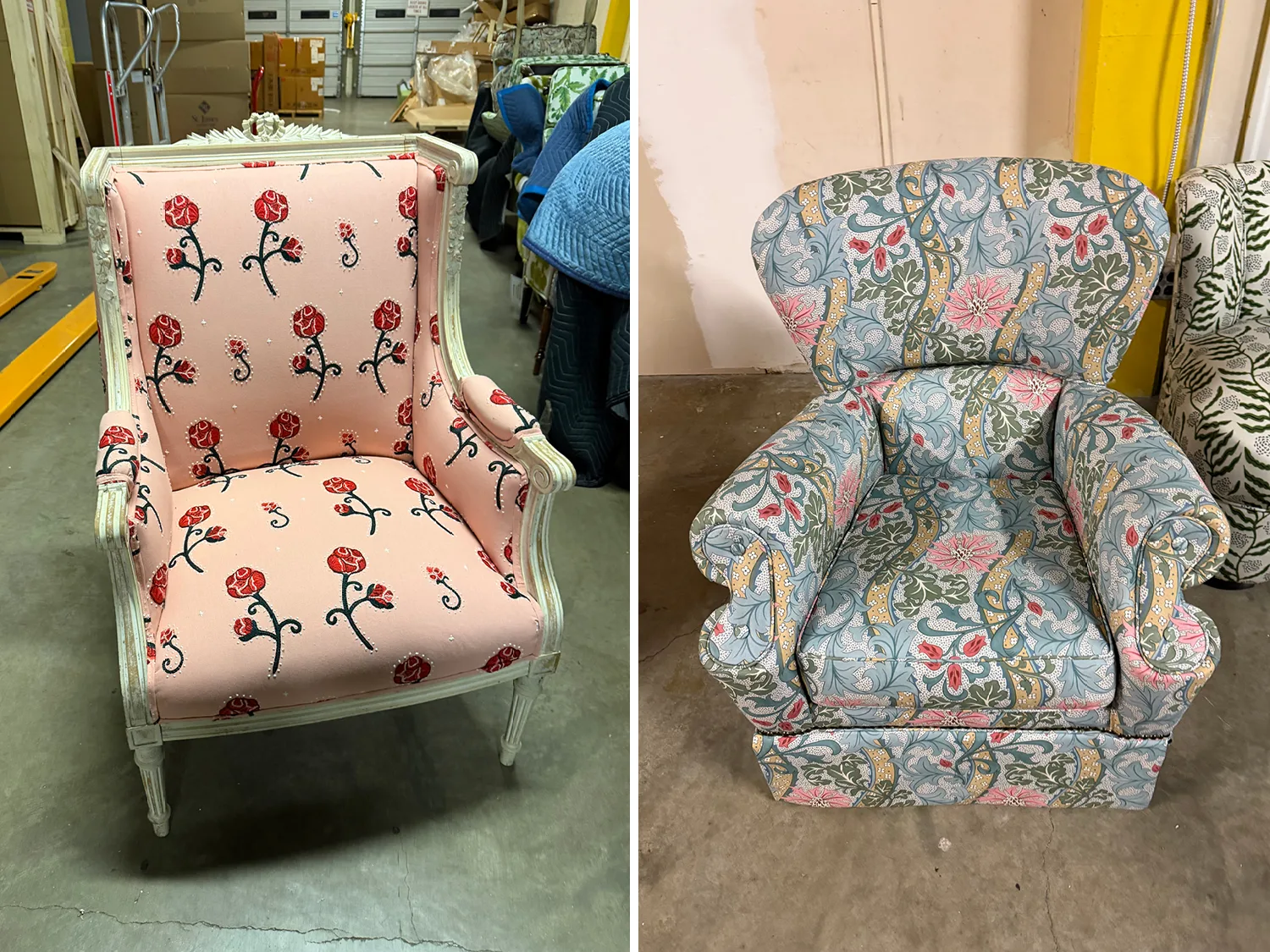
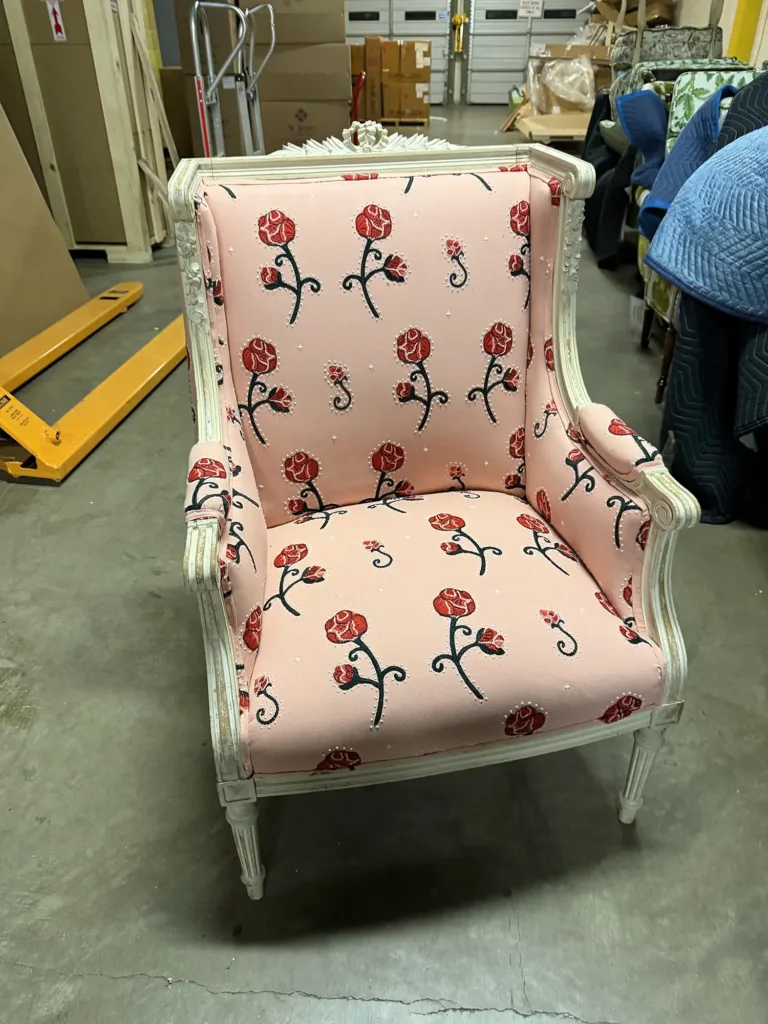
This carved French chair, part of a pair, were originally covered in a gray velvet fabric. To imbue them with new life, Jewell chose a delicate, whimsical floral to offset the chairs’ more serious look. “Gray is fine but I wanted to do a fun fabric,” she says. The new, stitched fabric from Schumacher lessens the formality of the ornate carvings. “People might look at these chairs and think, Oh, how formal. But you can take that down a bit and put a little fun into them and still have a classic, beautiful chair,” she says.
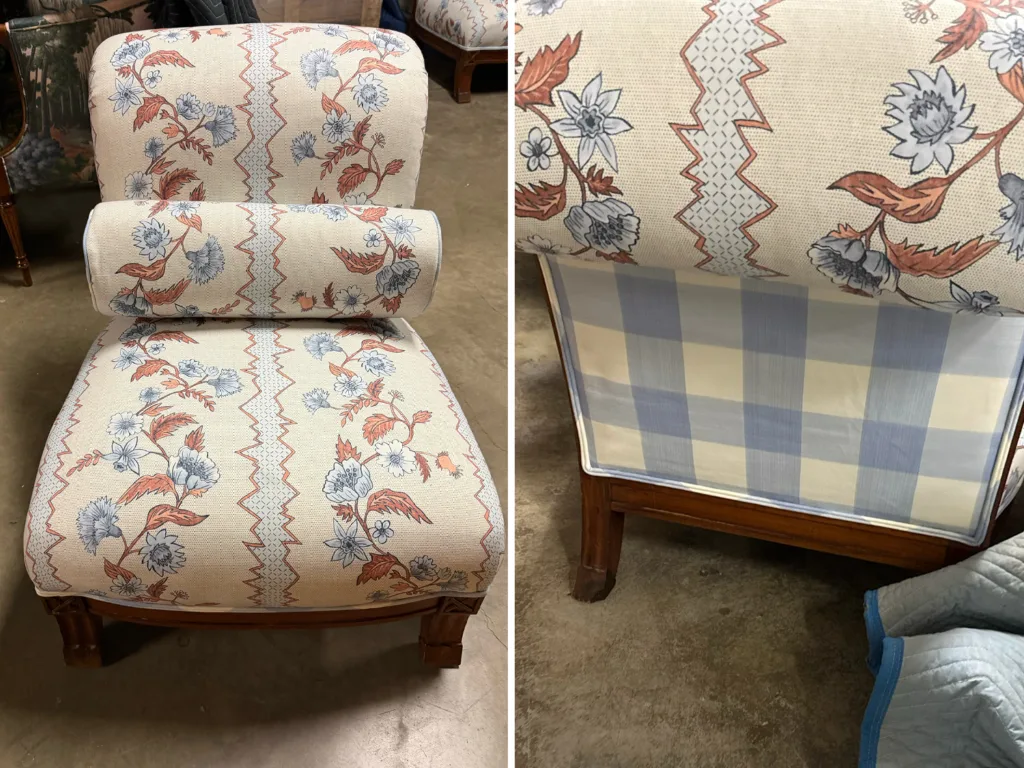
Think about the details.
Jewell appreciates an element of surprise in her work. Here, she played with two fabric patterns, including a blue-and-brown floral with a center stripe and a blue-and-white Buffalo check. “If the chairs are angled the right way in a room, you’re going to see the back of them, too,” she says. The chair’s bolster pillow has also been expertly upholstered. “The detail in the [stripe] makes it look like it’s one with the chair but it’s not. It just matches perfectly,” she says.
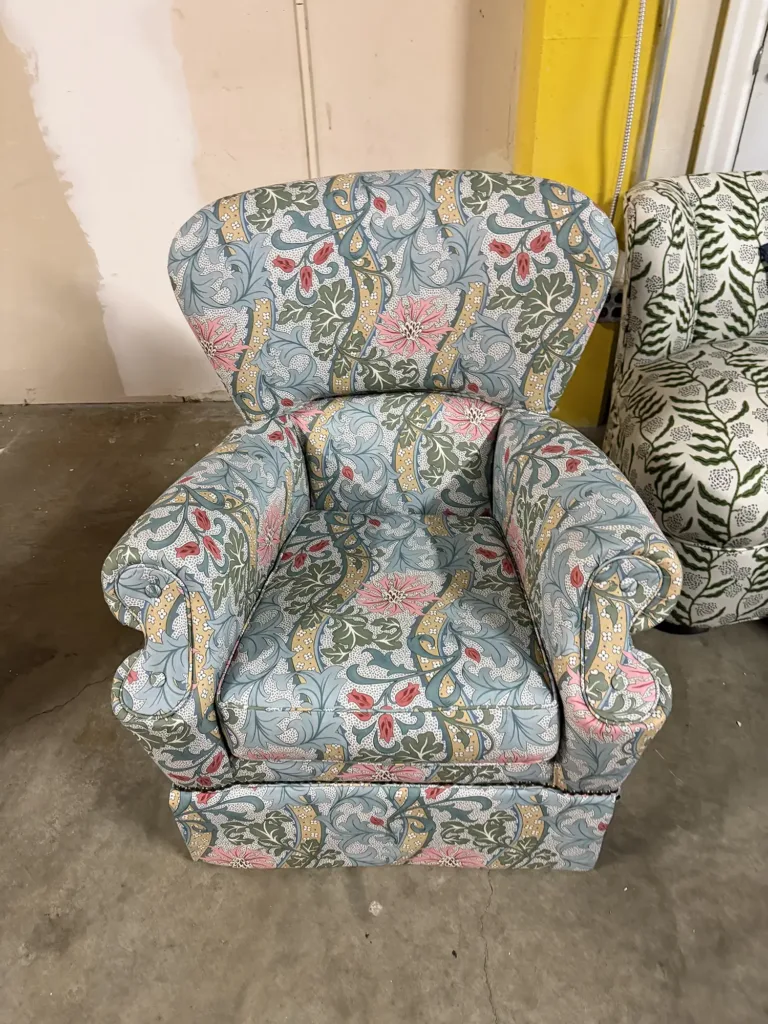
Appreciate the unexpected.
These chairs, which are originally from Italy, arrived in a “dingy-brown” fabric, says Jewell. “There are some really pretty browns but this was not a pretty brown,” she says. Still, the designer saw potential. During a meeting with her fabric rep, she spotted a classic floral pattern from the William Morris Archives that she thought would work well on the chairs. “I love meeting with reps because they show me different lines of fabrics and collections,” says Jewell. She ordered 18 yards and remembers thinking, I don’t care if they sell. Maybe I’ll use them in my house. “They’re so comfortable and I love them!” she says. Look closely and you’ll notice buttons on the face of the armrests. “They’re just so sweet,” says Jewell. As for the fabric itself, it ticks a few boxes for the designer: It’s green, it’s floral, it’s classic. “It just makes me happy,” she says.
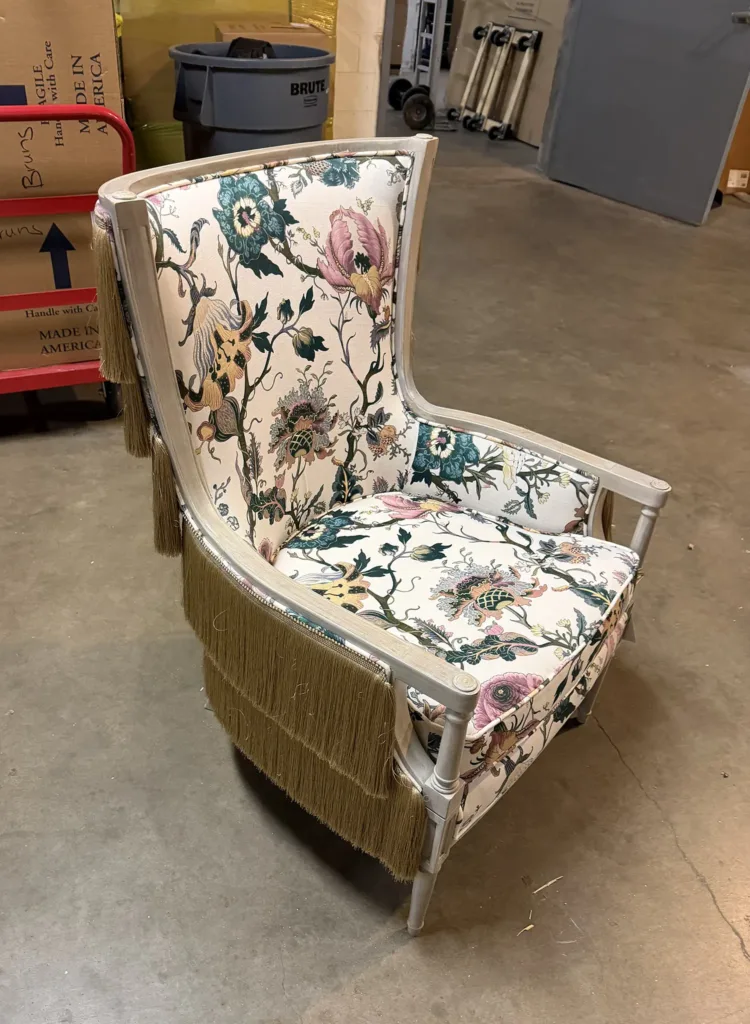
Take inspiration from fashion.
Something about these chairs made Jewell think flapper. “I’m seeing the back of this chair and thinking, it would be so cool if I did a trim and layered it on the back.” The fringe, a silk-and-poly blend from Samuel & Sons, is so unexpected it makes people want to touch it. And they can. The trim can be professionally steamed and the fabric itself is an indoor/outdoor fabric from House of Hackney. “I sometimes think how you dress, too, is a representation [of your interior design style],” says Jewell. “I love to mix a plaid and a floral. If I have a plaid pair of pants on, you’re probably going to see me in a floral shirt. And maybe a cool blazer,” she says. So, where did Jewell learn to be so bold with her choices? “Maybe that’s from my mom. I’ve always seen her wear these awesome pieces. And, my gosh, that looks so cool,” she says, “You can translate that into fabric, too.”
A note on durability.
“My kids can sit on every piece of furniture in my house,” she says. “I like to design with that in mind.” When looking through fabrics, she always suggests looking at the number of double rubs because “those will tell you what you can and cannot do.” Anything above 10,000 double rubs is suitable for upholstery, but Jewell prefers anything 30,000 and up. She also has her upholstered pieces sealed with Fiber-Seal, which locks in certain elements, such as stitching. Her final note on wear and tear? Take your samples and rake your nails across the fabric to see if it pulls. “I’m just always thinking about these things,” she says.