Tucked amid the fast food, Topgolf, and Target signs, just off Grand, is a hidden gem of an arts space. Just follow the welcoming glow through the walls of windows, and it will lead you to the doors of the Neon Museum of Saint Louis.
Inside this ever-glowing space are relics of businesses and products, contemporary sculpture, and striking signage, all rendered in neon. A red Schnucks sign glows on the wall. Jellyfish-like sculptures dangle from the ceiling. As you flip on the lights in the bathroom, the “No” side of a “No Vacancy” sign clicks on high above. The collection is a labor of love for museum director Deborah Katon, who’s both a sculptor and a collector. While running the Neon Museum, she’s also become a bit of a scientist.
Stay up-to-date with the local arts scene
Subscribe to the weekly St. Louis Arts+Culture newsletter to discover must-attend art exhibits, performances, festivals, and more.
“I never thought I’d be talking about science, but then you realize, Well, we’ve got electricity everywhere,” she says. Walking through the museum with Katon is a bit like taking a tour with Bill Nye the Art History Guy. She stops to explain the various noble gases and the way that pressure in a glass tube makes light jump and “snake.” Then she stops to page through a handy binder on the history of neon sculpture.
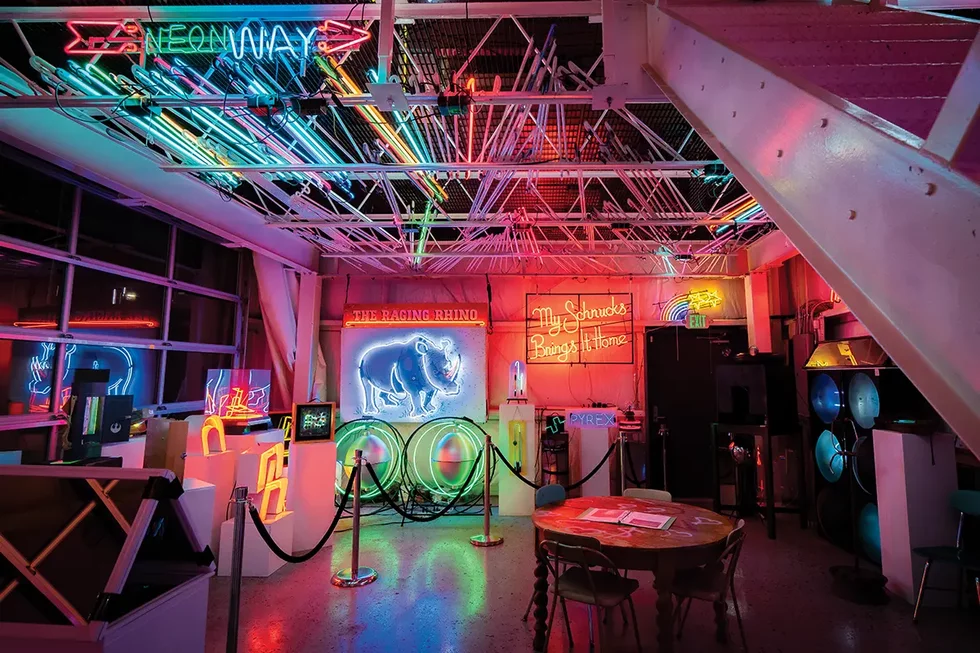
Katon’s had time to nail down such details. The Neon Museum of Saint Louis began as a pop-up show, then officially opened as a nonprofit in October 2022 in a space that formerly housed her late husband’s collection of antique and classic motorcycles. Today, the spirit of the road still inhabits the space, which sits on historic Route 66 and houses plenty of signs that travelers would have seen in decades past, as well as more recent art pieces. In addition to regular visitors, who are welcome four nights per month, the space has hosted dance parties, music videos, modeling shoots, historic tours, running groups, and more.
“When it started, I didn’t have a plan—it kind of happened by accident. You make plans, but I never planned on this,” Katon says.
Nonetheless, the Neon Museum continues to collect accolades. In recent years, it’s been awarded grants by the Regional Arts Commission and St. Louis Civic Pride Foundation. Its Google reviews are glowing too, with an average score of 4.9.
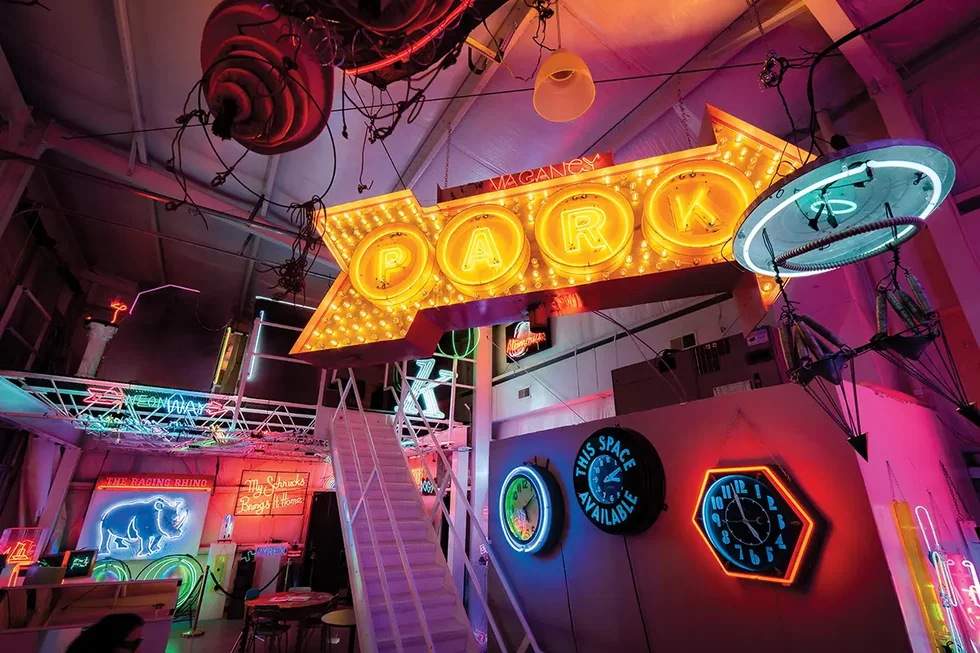
Katon says there are plenty of things to anticipate at the museum this year. Restoration projects on historic pieces are underway, and it will host a series of art openings. The current show is its annual neon clock exhibition, which features an array of glowing timepieces in various colors and styles—it runs through January 25. Through all her work, Katon hopes to continue her mission to “brighten the world through color and electricity,” just as the neon has brightened hers.
“Color induces dopamine, and when you stick electricity with that color, you just feel good in here. Nobody ever walks by and goes, ‘Ugh, I hate this stuff,’ you know? You just like hanging out with it. It makes you feel kind of calm and nice,” she says. “That’s kind of why I did it. After my husband died, I liquidated the bikes, and this environment…. It just makes me feel happy.”
The Neon Rainbow
As Deborah Katon explains, although nearly all lit signs are called neon, different gases create the color in the glowing lights. Here’s a quick primer on what’s being electrified inside the tubes.
Neon: Produces red-orange, or paler red or pink with higher gas levels
Helium: Produces shades of light pink; sometimes added to mercury and argon so light can heat faster in cold areas
Argon: Produces lavender or light blue; combined with mercury vapor to produce vibrant blue, yellow, green, or white
Krypton: Produces a white-gold glow; often used with colored glass to produce a colorful glow
Xenon: Produces a deep lavender on its own; creates a wide array of colors when blended with other gases
Mercury vapor: Produces a light blue glow; can be added to other gases to produce green or purple