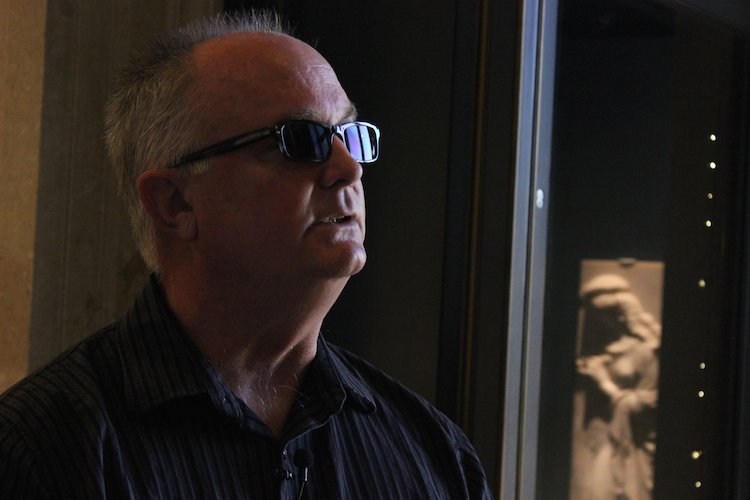
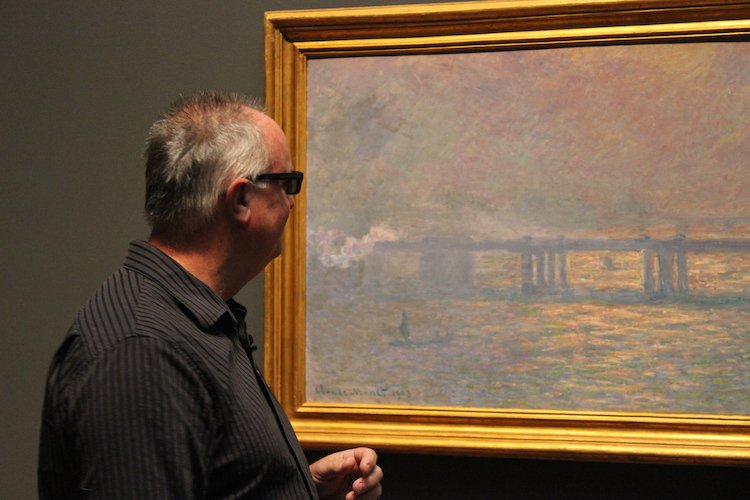
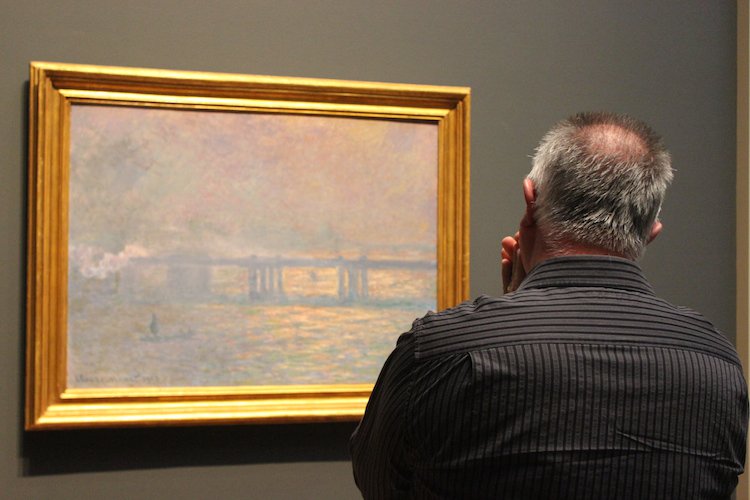
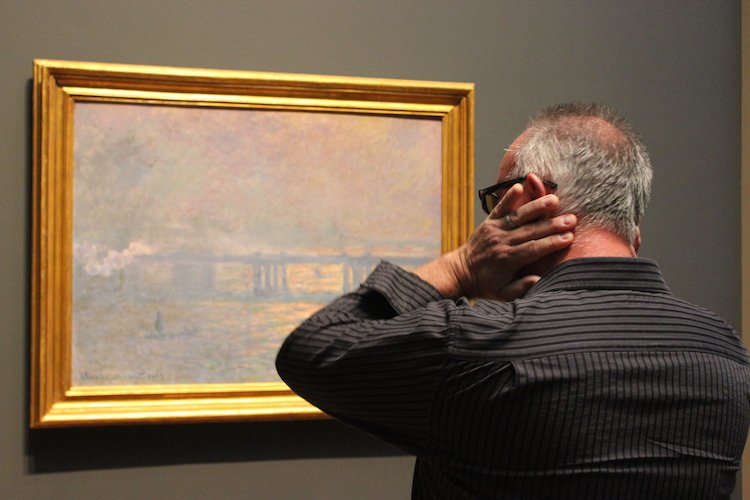
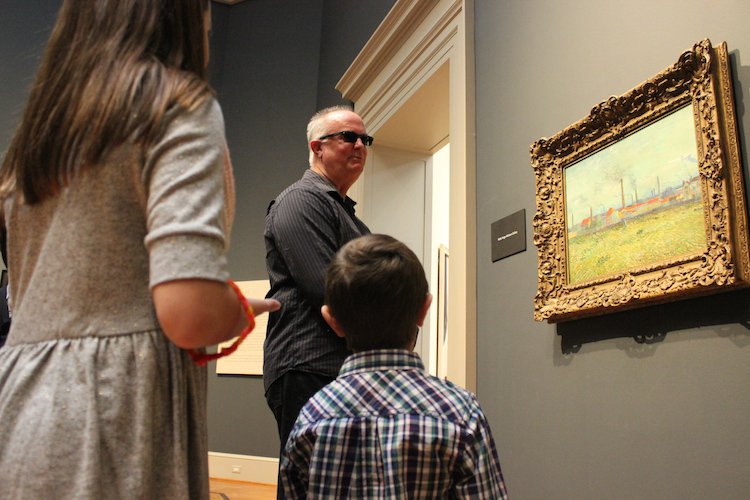
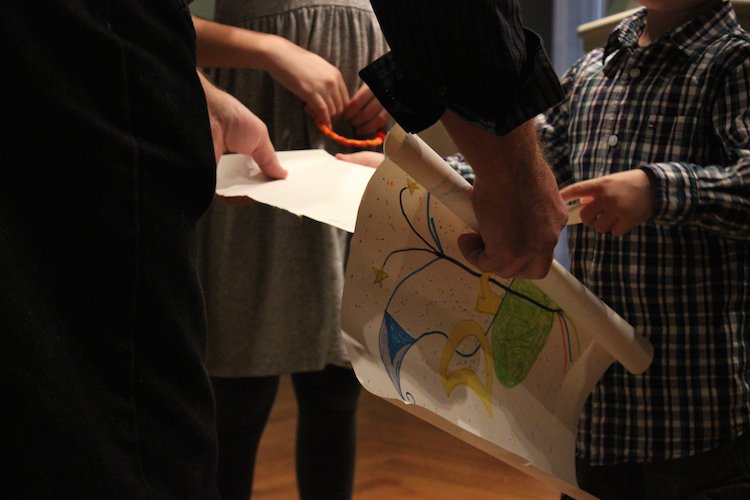
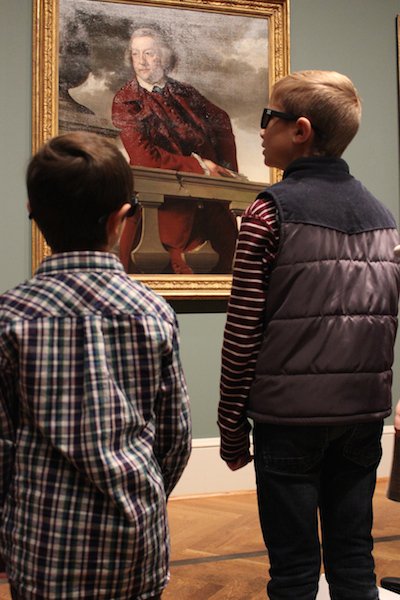
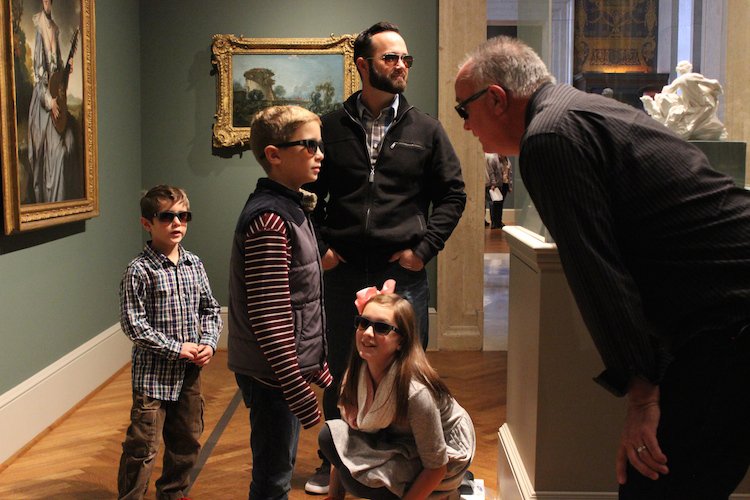
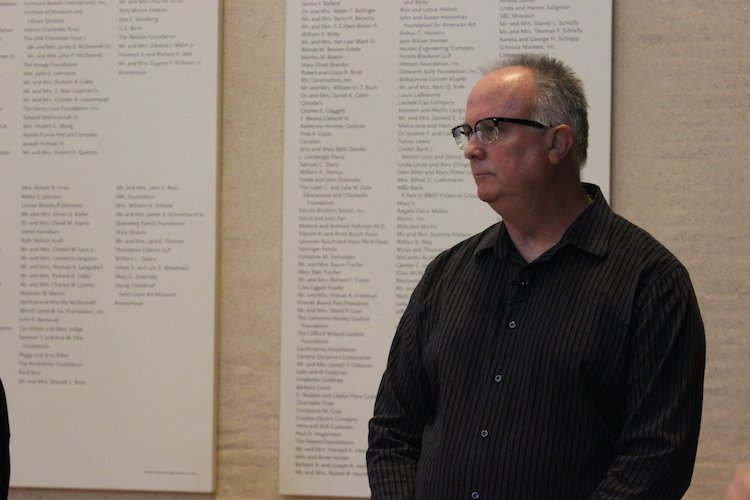
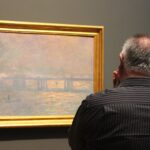
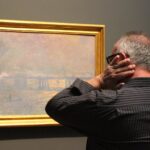
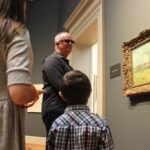
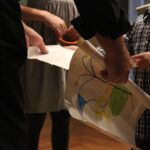
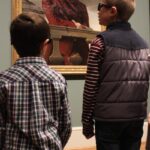


The scene at the St. Louis Art Museum between renowned artist Ray Harvey and his family—wife, children and grandchildren—was moving enough to bring a tear to this curmudgeon’s eye as a lump formed in my throat. Ray Harvey, who most recently painted the Clark Terry mural in Carondolet, was presented special glasses that assist the colorblind. Ray put on the pair and gazed upon a Monet. Clearly moved himself, he held his head in both hands; the feeling he must have known was palpable. (Click through the slideshow above for photos of the emotional reveal.) It was to behold Monet’s painting and other paintings throughout SLAM in their natural colors and lights, to behold the eyes of his wife, Paula, to see the deep brown of his grandson’s eyes, to watch the day outside through a new technology.
Ray and I are friends. In a moment of sheer humor, he put the glasses back on and claimed I was still ugly. I laughed so hard I had to exit the room for a bit. In the following interview, Ray disabuses us of what we think when we hear the word colorblind. I had the opportunity, as has often been the case, to learn from his words and explanations and wit:
Stay up-to-date with the local arts scene
Subscribe to the weekly St. Louis Arts+Culture newsletter to discover must-attend art exhibits, performances, festivals, and more.
So, it’s been a few days since you put the glasses on for the first time. What’s new?
Is to say “everything” a fair answer? I learned it’s possible to be born again visually. After 57 years of drab sight, and after so many battles with color, I think I just won the lottery. Looking back, you might say the best or most important day of your life could be your marriage or your children’s birth or another milestone. Not to diminish these, but Sunday was the most important moment for me personally. I don’t think I will, but I never want to forget the sight and feeling I had when I first laid eyes on that small Monet painting. Life changing. I knew what I hoped I would see, and I told myself how to handle it, but sometimes you just can’t ignore a feeling so strong that it knocks you off of your feet. I really never imagined what I would see. I wasn’t ready for it but I guess there was no way I could have. It was a case of not knowing what I didn’t know.
What do you see differently?
Well, there have been a lot of firsts. My first sunset and sunrise was pretty memorable. Did you know the sun really is golden and not just a soft yellow? My first red and green signal light. My first look at my own art, and the first time I really saw my wife’s eyes. Her eyes were said to be green, and I guessed that’s what I saw, but not to the extent I do now. That pretty well describes my sight now. I always saw color, but never with the intensity and subtleness, the depth or the mixture of tone. I can now speak the language most other people can. Before, I was a writer that couldn’t tell the difference between a “T” and an “S” but was expected to write a bestseller each time. Intense pressure. Now I’m an equal. And it’s not that the world is neon, it’s just that all of the world just looks better. It just looks right. I see a balance between the colors, I see warmth and I see separation. I can safely say I am stopping to see the roses. Paula watches me look at things.
What are your thoughts about colorblindness now?
First, I was never colorblind. More accurately described it’s called Color Vision Deficiency. I wasn’t blind, and I could see color. Being an artist with this deficiency caused me to view things in a different way than others. What colors I didn’t visually see, I saw by association. What this means is that if I couldn’t see a green, I would still know it was green, because I was looking at leaves, a bush or grass. The sky is blue and wood is brown. That’s association. It’s very similar to a person who can’t read—he figures it out. Not by reading, but by association. But I had no idea of the color range that existed, and the subtleties and fading of colors. I could always see colors as others do, but only in the right situation, light or use. Now, it’s all more obvious. The disappointing thing about the condition is the attitude of others. Color deficiency does not take lives; it does not change the world. The worst thing that can probably happen is someone dresses funny or the living room is poorly decorated. Big deal. It’s actually kind of clownish. But not to the sufferer, and certainly not the artist. I have lived my life trying to create quality paintings. Just imagine the challenge of matching colors that you can’t see. I relied on color theory a little more than some artists, maybe. I painted by the book, not by sight. I mixed colors based on my faith of what they were supposed to do, not what I saw them do. If someone didn’t like my color choices before, they would just assume it was due to my condition. Now, they have to accept that I meant to make those choices. Even accurate color needs to be questioned. Is there really accurate color? Now, I think color is pretty subjective, while last week I thought it was absolute. Red was red and green was green. Nothing can substitute seeing natural color as it is, but as an artist, what you choose to do with it is most important. Before these magic glasses, I relied more on the value and contrast of colors. Like the hearing of a blind person gets stronger, my sense of value became hypersensitive. This value judgment will always be strong and should actually enhance my use of color. Sometimes accurate color sight alone doesn’t guarantee a beautiful painting. With this said, I’m hopeful that my best art is ahead of me.
What has been the response of family and friends with this new vision?
I can get emotional just thinking about this. My family made this happen. Only they truly understood the battle I’ve been in. My wife would have given her own eyes to me had it been possible. I know they hated watching me struggle with every job. They learned about EnChroma glasses, and did all of the research. They wanted to keep it a secret and privately surprise me but with the media having an interest in my story—I was told prior to the reveal. I’m glad it worked out that way. My sight has been so personal to me all of my life, that the mere thought of relieving this condition is a dream I couldn’t imagine. I was overwhelmed when Paula explained it all to me, and I don’t really think I’ve been the same since. My family came together and did it for me. And as a result, my son-in-law and three grandchildren were diagnosed, and also received the EnChroma glasses. It was fun for me also to see their response.
Regarding my friends, my true friends will support me. They may not ever be able to understand what this does for me, but they are happy for me. I will see how this affects my customers, patrons, peers and fellow artists. It’s a dangerous thing to publicly admit this condition existed. Some may lose faith or respect for my work. They shouldn’t, but some might. So far, the few I have told the story to were sincerely thankful and happy for me. That means more than I can ever describe. I feel like I’ve just come out of the red/green closet. Who knows what customers or others might think? If the project is between a few other artists and myself, who will be chosen? The colorblind guy with the funky glasses? Or, perhaps it’s only paranoia. Usually it comes down to your body of work, and I’ve done plenty. Regardless, eventually it won’t be news anymore and I’ll be judged by my work as before.
Do you really understand how the glasses work?
No, not regarding the science behind it. But if I were to list what I would need altering glasses to accomplish, these do it all. The color is more saturated, but not to the point of being false or weird. The color separation is sharp, so everything has more depth. And so far they have never been wrong when identifying color, or…I have never been wrong. Part of my new challenge now is confidence. Not seeing colors accurately for so long led to self-esteem issues and doubt. Regardless of how well I painted, deep down I knew I was never as good as that other guy because I knew I had this condition. I will eventually be confident in what I’m seeing not to question any longer. I’m learning there are some weird color combinations out there.
Have you viewed and critiqued your own past artwork?
Not to any great extent yet. I’m very happy and proud of all of the work I have created over the years. You don’t get 350 mural commissions by chance. While I know my new art will be created differently, none of my past paintings will be any less successful. I don’t think I would have been named artist of the PGA Championship if my work were lacking. There was a little green used there. Most likely the changes that I make from now on may not even be noticeable to the viewer. I am excited to explore new processes and approaches that were unrealistic before. We will just have to wait and see how or if my work changes. I do have a sunset beach scene on the wall now I plan to revisit. There are just a few things I want to take a little further. It looks good now, but could be made better. I want to mimic some of the sunsets I’ve been viewing. I want to paint it more by my sight experiences, not by the book! I really just can’t wait to paint more. I have so many ideas on ways to enhance my process. My approach was so elementary before. I plan to paint more with subtle glazes rather than primary solid colors. Even when I do paint in bold strokes, the strokes of color next to each other will change. This is something I could never understand before. Colors change immensely when placed next to others. I wasn’t taking advantage of that. Time will tell, but it’s exciting to think I can begin a new chapter in my art. Few people get that chance. At my age some could be winding it all down. Not me. I’m just getting started.
Any more thoughts?
Well, I was thinking the other day, what would Claude Monet think? What would he think of my new response to his painting? So many years later and a guy from the 21st century is using technology to view his work. Who would have thought? Not me.
As we filed out with the Harvey family into the bright, cold day, I felt grateful to have witnessed, just before the holidays came into full swing, how a family with so many splendid members can act and treat one another. I was wondering how it must have felt to be a grandchild again, carried and picked up by a man—in this case Mr. Ray Harvey—and to be showed what the world looks like while being loved. I think it is the love of the Harvey family, that shared bond, that brightens colors and lights the way for those of us who do not, at least in my case, often appreciate those better souls that are around us. I keep my darker thoughts to myself, as should be the case. But after watching Ray hoist his grandson up onto the stone balcony overlooking Forest Park, I too felt there was good hovering all around us and then I stole or took what I could. I kept it in an invisible place, a place that Ray Harvey always guides me back to through his art, and his example of what it is to be a man and friend.