Built on site at Laumeier Sculpture Park in 1980, “The Way” has been the park’s pièce de résistance for more than 40 years. But decades of wear and tear on the 18 salvaged steel oil tanks that make up “The Way” meant that sculptor Alexander Liberman’s iconic work required more than a fresh coat of bright red paint. Creeping rust and chipped concrete were among the reasons it needed a little TLC. This past fall, Laumeier administrators kicked off an eight-phase project to restore the hulking abstract formation. “We wanted to approach it in the most holistic way,” Laumeier curator Dana Turkovic says. “Instead of just saying, ‘Let’s repaint it,’ we wanted to understand what’s going on with the sculpture and the materials.” This spring, parkgoers can expect a refreshed version of “The Way.”
Look Inside
Stay up-to-date with the local arts scene
Subscribe to the weekly St. Louis Arts+Culture newsletter to discover must-attend art exhibits, performances, festivals, and more.
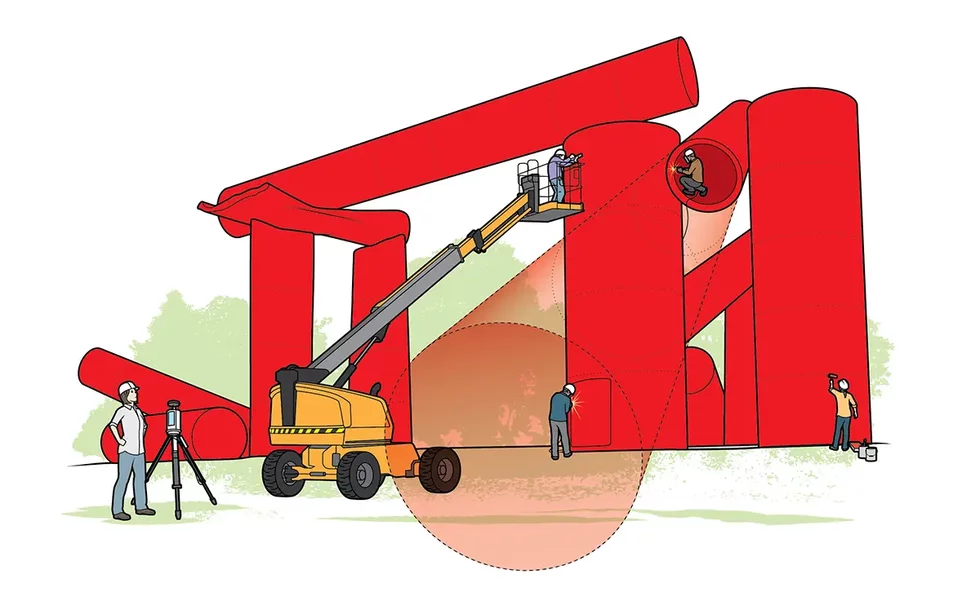
Frontenac Engineering scanned the thickness of the steel in areas where there was visible rust and to determine whether the sculpture was rusting on the inside.
Totally Tubular
A 54-foot section of the angular tube that extends toward the back of the sculpture was removed and replaced.
In the Middle
Two doorway-sized sections of the large center tube were removed, and new patches of metal were welded in their place.
Stable Base
The concrete slabs on which the sculpture sits were resurfaced.
Deep Blast
Loose paint was blasted away, as were the remnants of old bird droppings, which can cause corrosion.
New Coat
Raised in Soviet-era Kyiv, now the capital of Ukraine, Liberman chose red paint because the color represented beauty in Soviet culture and it set the sculpture in contrast to the surrounding landscape.