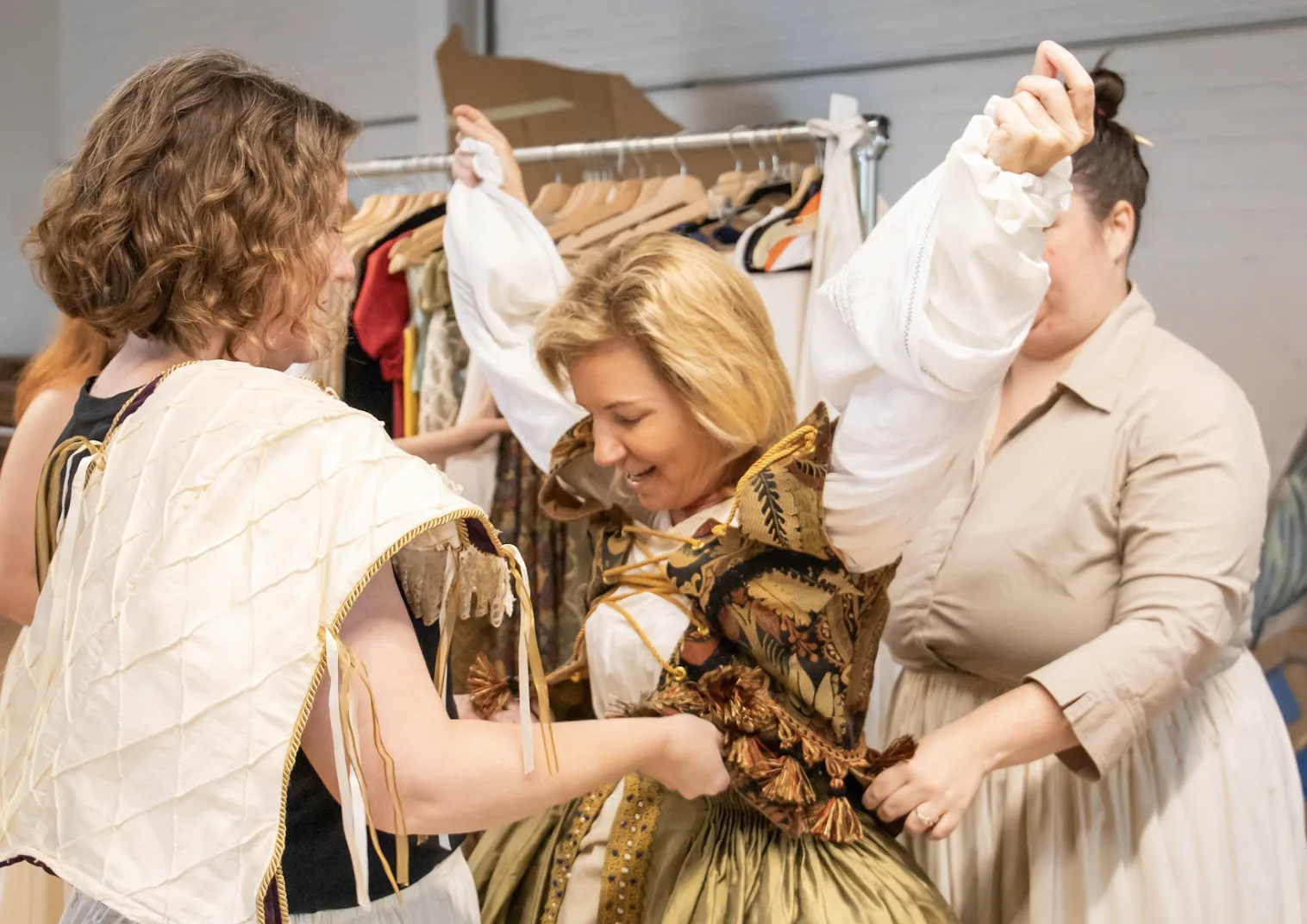
In Elizabethan England, the real royal court was never composed of men. Perhaps formalities and decorum took place in an organized meeting area within castle walls, and most of those allowed inside were men. But for Queen Elizabeth I of the Tudor dynasty, the big decisions, dialogues, and strides towards progress happened in her private chambers. And her closest advisors? The ladies helping her dress.
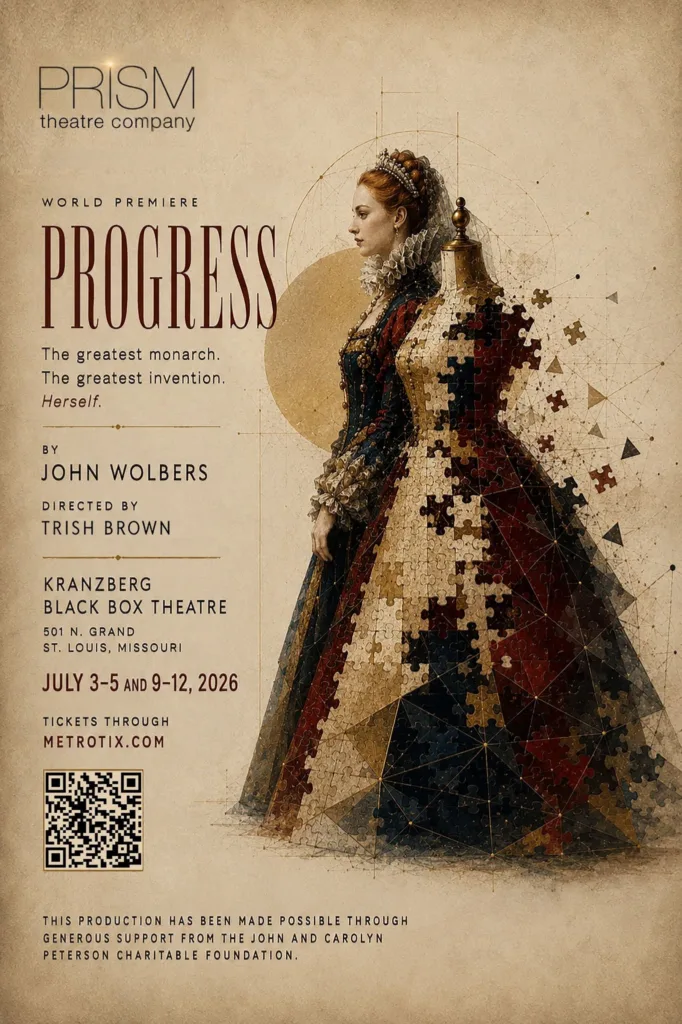
The concept may sound strange to fresh ears, but that is what PRISM Theatre Company’s world premiere production, Progress, is for. The new work is a “historical and hysterical” play showing audiences how an inner-circle of different women utilizes their strengths to pilot through war, plagues, and leadership.
Stay up-to-date with the local arts scene
Subscribe to the weekly St. Louis Arts+Culture newsletter to discover must-attend art exhibits, performances, festivals, and more.
“The women dressed her, prepared her for every meeting, represented every part of the country, represented different economic statuses. They were real people she was listening to,” playwright John Wolbers says.
Although many films and theater productions represent Queen Bess as one woman surrounded by male counterparts, Wolbers enveloped himself in a year’s worth of research, learning how the typical background “maid” role in Elizabeth I’s household was not an accurate depiction of what really went on behind the curtains.
To stay true to the real story, the cast of ladies could not be backdrop characters without lines or names—each one is a lead. Wolbers thought of a handful of local actors, usually in female powerhouse roles surrounded by men, whom he seldom saw working together in unity. In particular, he could hear the voice of Michelle Hand speaking the queen’s lines.
“The story is a way for audiences to ask themselves, What stories am I being given? How much power do I have in my own life to control my story? I want to be a part of that larger world conversation,” Hand says.
Despite the play’s Tudor setting, the team behind Progress hopes the play still connects with women’s roles in present positions of leadership and opportunity. Trish Brown, founder and producing artistic director at PRISM and director of the play, says one of the theater’s missions is to uplift and support the work of women and to shine a light on human condition.
”That’s really important to us, especially in these times that seem to be rather fraught with challenges in our world,” Brown says. “Progress specifically gives those opportunities to women, and shows that a strong, woman leader is someone who surrounds herself with people who tell her ‘no,’ and who can also encourage when she might be afraid.”
Alongside Hand, actors Nicole Angeli, Zayana Brown, Sarah Lantsberger, Margeau Steinau, Rachel Tibbetts, and Carly Uding demonstrate the power of a female network, making up a team of individuals whose unity sparks action and advancement.
Wolbers adds that the play’s boisterous costumes alone—intricately crafted by wife Liz Henning—are an excellent example of women taking up space in leadership. Brown also notes that the lighting design and original music are a reflection of the play’s line, “a womb of creativity,” signifying the nurturing and care that we sometimes see in female power.
There is vulgarity, comedy, moments of gravity and aching—all the emotions and qualities likely to bubble up when seven women each have a hand on the reins. As they bustle about the queen’s private chamber, they will navigate war, plague, schemes and struggles—and perhaps emerge from them stronger for having weathered the storms together.
Progress runs July 3-5 and July 9-12 at the Kranzberg Black Box Theatre, 501 N. Grand. Tickets are available through metrotix.com.
Editor’s note: The June 30 edition of the Arts + Culture newsletter misstated the title of the play in its subject line. Progress is the correct title.