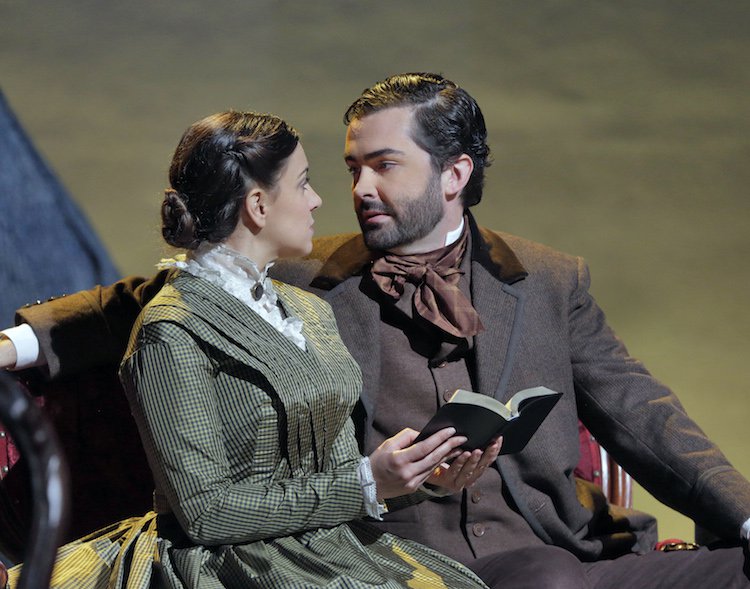
When the lights come up on Opera Theater of St. Louis’s Emmeline, the stage is daringly bare.
There is no set, simply a cluster of silhouettes surrounding a stark, wooden gravestone. The opera begins with a single voice, the first notes eerie and disturbing—Emmeline is not afraid to make the audience uncomfortable.
Stay up-to-date with the local arts scene
Subscribe to the weekly St. Louis Arts+Culture newsletter to discover must-attend art exhibits, performances, festivals, and more.
The story opens in 1841, when 14-year-old Emmeline Mosher is taken from her home and family in Maine to work in a bleak textile mill in Lowell, Massachusetts. The son-in-law of the mill owner, Mr. Maguire, notices her on her first day, and quickly seduces the young, naïve girl. Emmeline becomes pregnant, gains a reputation as a “ruined woman,” and is sent away to live with her austere Aunt Hannah. Before Emmeline can even see her baby, Aunt Hannah gives it away to a couple for adoption—but Emmeline dreams about her baby every day afterward, secretly naming her Maryanne.
Twenty years later, Emmeline runs the family boarding house in Maine. When a young boarder named Matthew Gurney arrives, he falls in love with Emmeline as she teaches him how to read. Despite their 14-year age difference, they hastily marry and begin a happy life together—but when Aunt Hannah pays a visit to meet Emmeline’s new husband, she makes a horrifying realization that changes Emmeline’s life forever.
Emmeline makes significant emotional demands of its performers, and the cast does not disappoint. While Joyce El-Khoury (Emmeline) has a stunning voice, it is her acting ability that makes her performance a memorable one. Through El-Khoury’s complete dedication to her character, Emmeline comes to life, growing from a meek girl to a broken-but-stalwart woman before the audience’s eyes.
John Irvin’s (Matthew Gurney) gorgeous tenor marries well with El-Khoury’s voice, and his acting ability shines when Aunt Hannah reveals Emmeline’s shocking secret. In a moment that could easily become melodramatic and forced, Irvin steps back, and his horror feels absolutely authentic. Meredith Arwady too (Aunt Hannah), treads carefully around this climactic scene, and successfully walks the fine line between drama and farce.
The score (composed by Tobias Picker) is a masterpiece, the ghostly melodies sprinkled with B-flat minors and harmonies. Even in the moments without lyrics, Picker achieves rare emotional intensity.
The brilliance of this opera, however, comes from the way the production itself concretizes the story’s themes. Subtle visual images repeat from act to act—when Matthew places Emmeline’s shawl around her in Act II, we cannot help but remember when Maguire placed his coat around Emmeline’s shoulders in Act I. These mirror images bridge the 20 years that separate the two acts, hinting at the unavoidability of Emmeline’s past. The most prominent effect is the production’s heavy reliance on the stage’s massive turntable, which rotates the scenes of Emmeline’s tragic life in an inescapable circle.
As a little-known opera with controversial themes and extremely demanding characterizations, Emmeline is uniquely demanding on both performers and audience members. Sparse, gripping, and hauntingly beautiful, Emmeline is undoubtedly a well-worthy risk.
Read our Q&A with Emmeline librettist J.D. McClatchy here.
The final performance of Opera Theatre of St. Louis’ Emmeline happens Saturday, June 27 at 1 p.m. at The Loretto-Hilton Center for the Performing Arts on the Webster University campus, 130 Edgar. Tickets are $25–$135, and can be purchased in person at the Opera Theatre box office, by phone at 314-961-0644, or online at experienceopera.org.