This morning, the Missouri Historical Society unveils its “We Are St. Louis” campaign. The $36 million initiative will pay for two sweeping new exhibits at the Missouri History Museum, an expansion of programming, and a major digital push showcasing its collection online.
But for all those ambitions, Jody Sowell, the organization’s president and CEO, says it’s even bigger than all that. It’s not just about launching important new exhibits or improving the experience for visitors. It’s about helping St. Louisans better understand St. Louis—and, by so doing, help them believe and invest in this place.
Stay up-to-date with the local arts scene
Subscribe to the weekly St. Louis Arts+Culture newsletter to discover must-attend art exhibits, performances, festivals, and more.
Can a historical society and its accompanying museum really do all that? Sowell isn’t only convinced of it, but is increasingly of the belief that it must do so.
“I’m oftentimes in meetings with other business and civic leaders, and civic pride will almost always come up: Why aren’t people prouder of St Louis? Why are we so down on ourselves? And I always say, it doesn’t just happen, it has to be fostered,” he says. “Someone has to build those emotional connections. And we are increasingly saying that the Missouri Historical Society will be a leader in building those kinds of connections.”
Hearing the way Sowell talks about the area’s complicated history, refusing to erase the dark side but weaving it into a narrative of conflict and triumph and heartbreak, it’s hard not to see St. Louis in new ways.
“Any story you want to tell about American history can be told through the lens of St. Louis,” he says. “The creation of the nation we know today? That’s a St. Louis story. How immigrants shaped the country? That’s a St. Louis story. Civil rights? Space exploration? Rock and roll? Those are all St. Louis stories. And urban boom, bust, and hoped-for revitalization? That is a St. Louis story, like so many St. Louis stories, that is still being written today.”
Those stories are also a big part of the two major exhibits that the “We Are St. Louis” campaign will fund. The first, Collected, launches this spring. As Sowell describes it, it’s a chance to put the historical society’s extensive holdings on display, without forcing the artifacts into service on a particular theme like the 1904 World’s Fair or St. Louis’ role in the civil rights struggle (both focuses of recent exhibits).
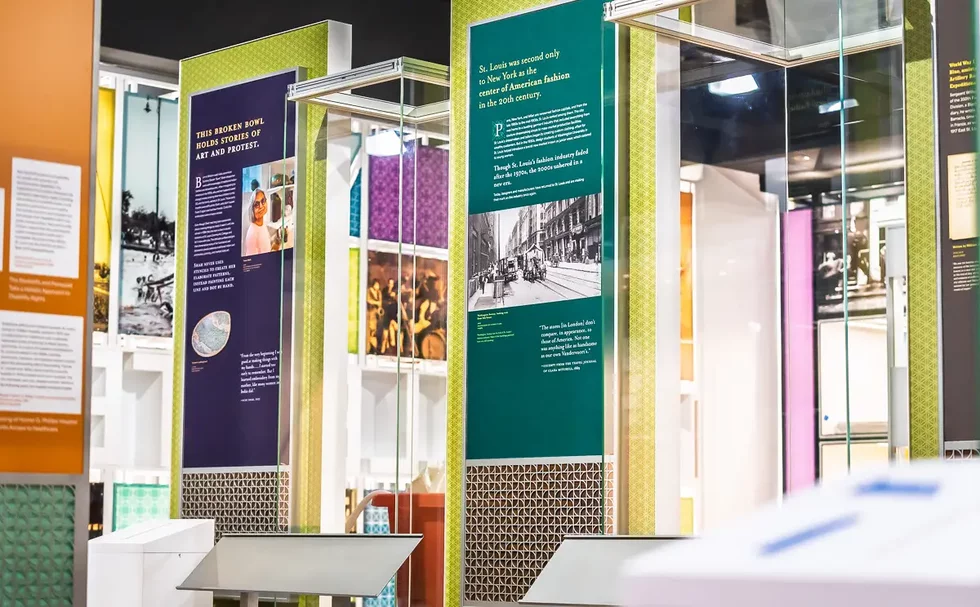
The first iteration, debuting this spring, contains 80 items—60 percent of which have never been on public display before. Every year, the exhibit will change to give new items their moment in the spotlight. Says Sowell, “You’ll find stories about St. Louis’ fashion history, St. Louis’ manufacturing history, St. Louis sports, the history of protest, history of race, history of gender, all kind of in there together. It’ll be creating these serendipitous moments where you just come across something that sparks your interest and, I hope, makes you want to dig even deeper.” A new online Collections Hub will showcase even more items on the museum’s website, with different features every month that explore its holdings and tell timely stories from them. “Our promise is we’ll share more of our collection than ever before,” Sowell says.
The second major exhibition funded through the campaign, Gallery STL, is slated to open in 2027. It’s a lot less random: A 12,000-square-foot decade-by-decade history of St. Louis dating back to its founding.
“Every decade gets its own mini display that will tell you both the biggest moment that happened in that decade, but also tell you what life was like at that time,” Sowell says. “What were people wearing? What were people eating? What was it like to go to the dentist in the 1860s?” He continues, “I think it really fulfills that promise to introduce you to a St. Louis you’ve never met, because in two galleries that stretch over the full second floor of the Missouri History Museum, you will get an overview of all of St. Louis history from the very beginning right up to the present and even into the future.”
It’s wildly ambitious—choices must be made; even seemingly dull decades must be enlivened. It’s propelled by that $36 million campaign, for which the Missouri Historical Society has already raised $30 million even though today is the day it officially launches. Sowell says that’s just strategic: Get the most devoted backers to commit, and then approach everybody else. You can read more about the campaign, and how to support it, online.
And today isn’t just launch day; it’s also St. Louis’ birthday. Part of “We Are St. Louis” will be making February 14 an annual celebration, a day not just of romantic love, but love for one’s city.
Fittingly for Valentine’s Day, the word “love” comes up a lot when Sowell talks about his relationship with his adopted city. A native of Memphis, Sowell came here as a doctoral student at Saint Louis University, earning a doctorate in American Studies after years as a journalist. He never planned to stay, but then, he says, he fell in love.
He quotes Peter Kageyama, author of For the Love of Cities: “When we love our city, as when we love another person, we will go to extraordinary lengths for them. We will sacrifice for them; we will tolerate their shortfalls; we will forgive their excesses – all because we see their true nature. When we have an emotional connection to our place, we are less likely to leave it and far more likely to champion and defend it in the face of criticism.”
That’s his hope for St. Louis. That’s what “We Are St. Louis” is aiming at, starting today with that 261st birthday celebration.
Acknowledging that March 14 is already very much a celebration thanks to St. Louis’ preeminent 314 area code, Sowell says that’s no reason not to get started now. “My dream of all dreams,” he says, “is that February 14 would be the start of a month-long celebration.”
Editor’s note: A previous version of this story referred incorrectly to Jody Sowell’s hometown. He is from Memphis. We regret the error.