In 2015, the St. Louis Post-Dispatch won a Pulitzer Prize for breaking news photography for its coverage of the protests following the police shooting of Michael Brown in Ferguson the previous year. One of the images, taken by photographer Robert Cohen, shows Jonathan Pulphus pouring milk on the face of the female protester who had been tear gassed.
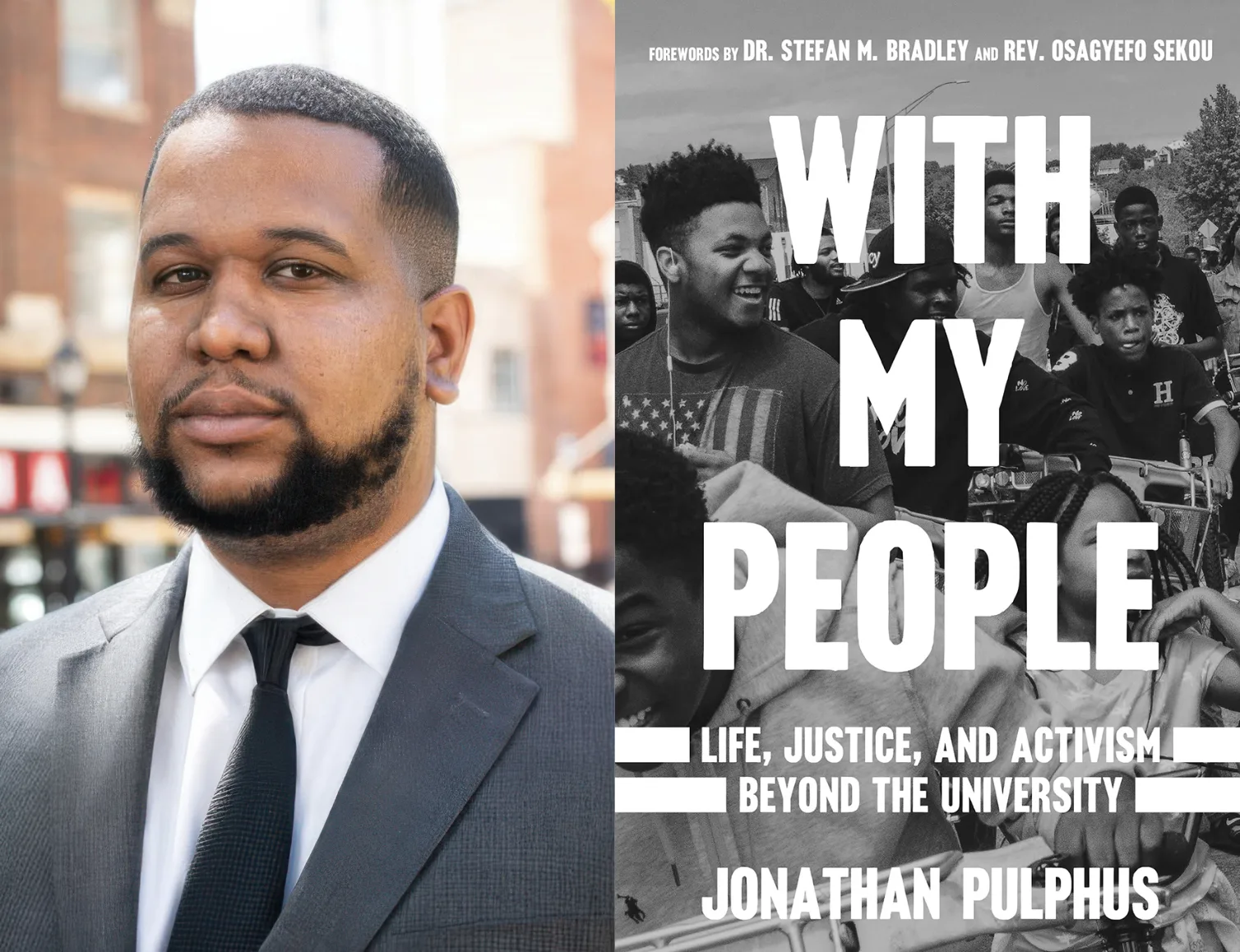
Pulphus, an equity advocate and organizer, was a sophomore at Saint Louis University when Brown, an unarmed, 18-year-old Black man, was killed by white police officer Darren Wilson, who claimed he had acted in self-defense. A grand jury decided not to indict Wilson, which sparked protests and outrage over charges of racism and police brutality. Pulphus, who graduated with a degree in African American Studies in 2017, writes about the nine months he spent as a student activist on the frontlines in the aftermath in his new book, With My People: Life, Justice, and Activism Beyond the University, out today from Broadleaf Books. Pulphus will discuss the new book with Lola Zasaretti, Dr. Stefan M. Bradley, Alisha Sonnier, T.R. White AKA Swagged Out Shawty, and Etefia Umana on September 20 at the First Congregational Church of St. Louis.
Stay up-to-date with the local arts scene
Subscribe to the weekly St. Louis Arts+Culture newsletter to discover must-attend art exhibits, performances, festivals, and more.
“As we were trying to seek justice for Mike Brown, I was concerned that the news reports misrepresented us and mishandled us,” says Pulphus, who now works as a grants director for a local non-profit. “If you weren’t here in 2014 and you got your news from Fox News, you’d think the only things left in Ferguson were burned-down buildings and liquor stores, that people out here were acting like animals, were unruly and there was no organization. What motivated me to write the book was to give a first-person lens into what was actually happening to help dispel a lot of those narratives.”
Born in North St. Louis, Pulphus says he and his siblings were raised to be “civically engaged.” So when he got the news from his mother about Brown’s death—two years after Trayvon Martin’s killing by George Zimmerman in Florida—Pulphus took action right away. He channeled his anger and frustration and co-founded Tribe X, a protest group made up of students and non-students who, among other things, confronted university administrators about their lack of immediate response to Ferguson.
“This was something that happened less than 15 minutes away from SLU,” Pulphus says. “But outside of the campus ministry and a few small departments, SLU’s response was tepid. It was saddening and disappointing.”
Pulphus took part in demonstrations, vigils, teach-ins, and a “die-in” within the Delmar Loop. He was arrested twice in 24 hours. Pulphus participated in a protest outside the Fox Theatre during a production of Annie and at the Saint Louis Galleria during Black Friday, where the protestors sang modified versions of Christmas carols. He helped organize OccupythePolice at the St. Louis Police Department and OccupySLU on the university campus. The six-day encampment led to the Clock Tower Accords, a 13-point agreement signed by former SLU president Fred Pestello aimed at improving racial equality and DEI at the university, including expanding the budget for the African American Studies program, increasing financial aid for African-American students, establishing a diversity speakers series, and creating college preparation courses for students in disadvantaged areas.
Pulphus insists that the events of Ferguson helped push Black Lives Matter—born the prior year as a response to the acquittal of Zimmerman—to the forefront as a political and social justice movement.
“Without Ferguson, there would not exist a Black Lives Matter as we know it today,” says Pulphus. “Our confrontation with the state and the energy we brought is what catapulted BLM, not only on a national level but international level. What we did in Ferguson was being mirrored around the country. The organization really owes to the blood, sweat equity, and labor of those on the ground in Ferguson. It made the movement a household name.”
Beyond acting as a memoir, Pulphus’ book also works as a how-to guide for aspiring student activists, with advice on graduating, balancing school and personal life, learning from past social movements, and overcoming disappointment.
“I give students the same advice that was given to me,” Pulphus says. “Activism is a marathon, not a sprint. Take risks, don’t be afraid to make mistakes and push against your comfort zone. Don’t feel like you haven’t achieved anything. This work existed prior to you. It belongs to a story that’s larger than you. On the flip side, I would also tell them that they still need to graduate. Just as you’re needed in your student life, you’re needed in your community. And you’re more in a position to do so once you finish your degree and you enter your community as a professional and public servant.”
Jonathan Pulphus will speak about With My People on September 20 at First Congregational Church of St. Louis (6501 Wyndown). The event is presented by Left Bank Books and the Left Bank Books Foundation. RSVP online.