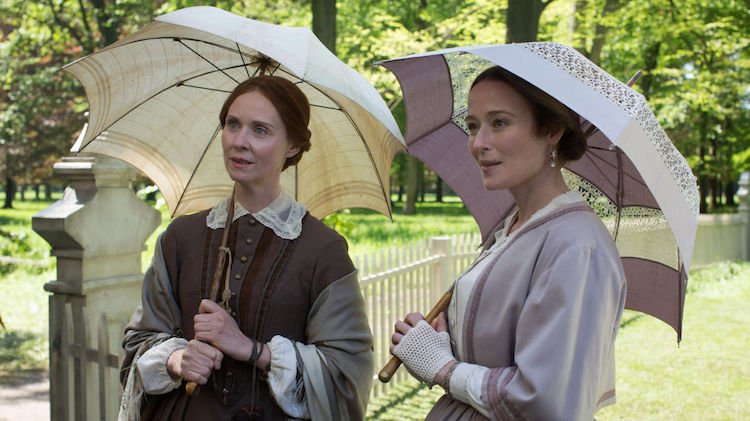
Few literary figures have enjoyed the sort of posthumous canonization that American poet Emily Dickinson has received. Her prolific work was virtually unpublished and little appreciated in her own time, but today Dickinson is widely regarded as a fountainhead of proto-modernist innovation in English-language poetry. Perhaps the greatest achievement of writer-director Terence Davies’ magnificent new film about Dickinson, then, is to banish any looming sense of historical import. A Quiet Passion is not about how revered the poet’s words would become to future generations, but about the agony and ecstasy of being Emily Dickinson.
Emily (Emma Bell as a young woman, and Cynthia Nixon later in life) is the middle child in a respected Amherst, Massachusetts family. Davies depicts Dickinson’s nascent willfulness in a scene where, as a student, she refuses to mime the proper public displays of contrition during a religious revival. It’s not agnosticism that compels her unyielding stance, but self-possession: Emily contends that her soul is a matter between her and God. This interiority in Dickinson’s piety prefigures the poet’s fascination with the inner world—the landscape of emotions, principles, and concepts—as contrasted with the outer realms of the tangible.
Stay up-to-date with the local arts scene
Subscribe to the weekly St. Louis Arts+Culture newsletter to discover must-attend art exhibits, performances, festivals, and more.
Inasmuch as A Quiet Passion has a plot, it concerns the Dickinson family and the succession of modest joys and piercing tragedies that it experiences as the years roll on: dinners, parties, friendships, courtships, marriages, illnesses, and a steady procession of deaths. Yet Davies’ approach is almost that of an anti-biopic. He presents these myriad happenings not as episodes in a period melodrama, but as the building blocks of Dickinson’s writing and worldview. The film is, in great part, a cinematic portrait of both Emily’s brilliant, troubled mind and the experiences that compelled her to put pen to page. Davies underlines this through voiceover readings of the poet’s work, which Nixon performs with a composure and thoughtfulness that almost seems aspirational, as though one were hearing the self-assured woman Emily wished she could be.
Nixon is undeniably the film’s heart and soul. To be sure, many of the performers shine, particularly Jennifer Ehle as Emily’s adoring younger sister Vinnie, and Catherine Baily in a scene-stealing turn as the poet’s wasp-tongued and defiantly modern friend Vryling. However, it’s Nixon that inevitably draws the eye in every frame. Her portrayal balances, trembling, at the unlikely intersection of scathing wit and suffocating melancholy. In Nixon’s hands, Dickinson is rendered an admirable and sympathetic figure, but also a self-loathing bundle of bitter misanthropy and obsessive morbidity. Her Emily is, in short, a real drag. The humane sorcery of Davies’ film lies in how clearly and effortlessly it illustrates the nature of Emily’s demons, all in a 19th century setting in which their true names—“chronic depression,” “anxiety disorder,” “suicidal ideation”—were still unknown. Vitally, the film also allows whispers of the notoriously unmarried Dickinson’s romantic desires to peek through the gloom, whether in her chaste infatuation with an eloquent parson, or in a dream about a midnight gentleman caller climbing the stairs, incubus-like, towards the poet’s bedroom.
Indeed, A Quiet Passion’s evocation of the melancholy mind is so potent, some viewers who struggle with depression and anxiety may find that Davies’ film hits too close to home. That caveat aside, however, it is unquestionably invigorating to encounter a work of historical biography that deconstructs the Great (Wo)Man of History model so subtly and completely, and in the process restores its subject’s humanity. Davies posits that Dickinson’s literary talents might have been exceptional, but the terrors and sorrows that directed those talents were as universal as they come.
A Quiet Passion opens Friday, May 12 at the Landmark Plaza Frontenac Cinema.