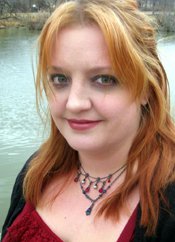
As a lover of haunted houses, thunderstorms, and the chilling novels of Daphne du Maurier, it seems fitting that Sarah Bromley spends her time penning Gothic fiction for young adults—or, to use her own words, “writing creepy things for teenagers.”
Though a good deal of Bromley’s time is spent in the solitary acts of reading and writing, she also loves meeting those teenagers and other aspiring writers, which is why she will be signing books and chatting with fans at the Left Bank Books Lemonade Social this Friday. Bromley, who will be joined by her friends and fellow young adult writers Heather Brewer, Cole Gibsen, Shawntelle Madison, and Paula Stokes, promises that the event will be “a fun, casual way to get to know us through real conversations.”
Stay up-to-date with the local arts scene
Subscribe to the weekly St. Louis Arts+Culture newsletter to discover must-attend art exhibits, performances, festivals, and more.
In anticipation of this Friday, we sat down with Bromley to talk a bit about her career, her writing process, and why she’s so attached to young adult literature.
On your website, you identify as a writer of “Gothic young adult fiction.” How did you fall into such a unique genre?
I was always interested in the darker things. From the time I was very little, I was always hearing ghost stories from my mother, who was a huge influence on me. She would read Poe to me as bedtime stories when I was five years old, so it’s no wonder I am the way I am!
When I went to college, I started studying Gothic literature and combined it with my love of young adult literature. I always knew I wanted to be an author and write for teenagers; I wanted to write the books I looked for as a teenager but couldn’t find.
Is there a particular reason why you chose teenagers as your audience?
Young adult is the age where I’m mentally stuck. It’s such a sharp age, so formative. I had a very tumultuous adolescence myself, so sometimes I’ll write about teenagers who have to face really difficult challenges. I know from my experience that there are real teenagers out there who deal with so much—but if those teenagers see a character who endures these kinds of hardships and still manages to get through it, maybe it’ll give them a little bit of hope.
If my readers take away anything from my writing, I hope it’s the idea that life isn’t fair, and that life can be really hard, but that wonderful things will happen, and life will go on.
What makes literature so important in the lives of young adults?
It’s a way to learn more about other lifestyles and other cultures. It’s a way to develop empathy for people who aren’t like you. It also just feeds that need to escape— it’s nice to have a book you can pick up and get lost in for a while.
What is your biggest challenge as a writer?
Drafting. I have it all in my head, and it frustrates me that I can’t tell the story fast enough. I just want to tip over my head and let the whole story fall out of my ear . It’s time consuming, trying to type and make sure that everything makes sense on the page as much as it does in your head, and it’s especially difficult with three young children. My writing time is a very precious commodity, and I get very protective over it!
Could you talk a bit about your creative process?
When a story first comes to me, it’s always the main characters before anything else. I get to know them, and then I ask them, “Well ,what’s your story? Who else is in your story? What are you afraid of most?” It really becomes an immersive process, obsessive in a way. At first, whatever the characters want to tell me, that’s what I throw on the page. After that, it’s sort of like braiding; you get all the different threads, then you have to weave them together in a way that makes sense.
It’s weird when you’re coming out of that story. You just look around and think “Wow, now what?” And inevitably, another character will come out of my head and start chattering.
I mean, we all sound completely insane when we talk about the writing process and our characters. But I think that’s sort of what defines the creative type—if you’re a musician, you’ll have a song stuck in your head that you need to compose or play. If you’re an artist, you have a vision in your head of what you want to put into the painting or photograph.
Writers, well, we hear our characters’ voices.
Bromley’s first novel, A Murder of Magpies, is currently for sale online and in local bookstores. Her next novel, The May Queen Murders (which will be released under the name of Sarah Jude), is due Spring 2016.
The Lemonade Social with Young Adult Authors will take place this Friday, June 12 at 5 pm at Left Bank Books, 399 N. Euclid.