Why did you write this book now?
I’ve been here almost over 20 years. This book really comes out because of teaching in St. Louis about St. Louis topics. I’m an urbanist, so I’m interested in the patterns of the city, the way it’s changed over time, the impact of economics on the changing form of the city.
Stay up-to-date with the local arts scene
Subscribe to the weekly St. Louis Arts+Culture newsletter to discover must-attend art exhibits, performances, festivals, and more.
Why do you think people are going to find something useful from this book?
At least in my own work, I celebrate complexity. Because that, to me, is where you really discover new potential. I can see what’s going on here and where the tensions are, but I can also see potential design solutions from that. Complexity is a great way to get to the real issues and to not forget those voices that are never in the decision-making. So for academics, there’s that side of it.
I think the book provides a view of North County and the region in a much more detailed lens and in a way that acknowledges some of the imbalance of power that we have in the region.
We’ve had a lot of reports. And they’re great, and they have a huge amount of information, but they’re focused on one in-depth study. This book is an attempt to look at a very large cross-section to see how these seemingly different topics are actually related and to try to think about the underlying economics of it and relative to decisions in the region.
So at what point did you say, ‘I’m going to use maps’?
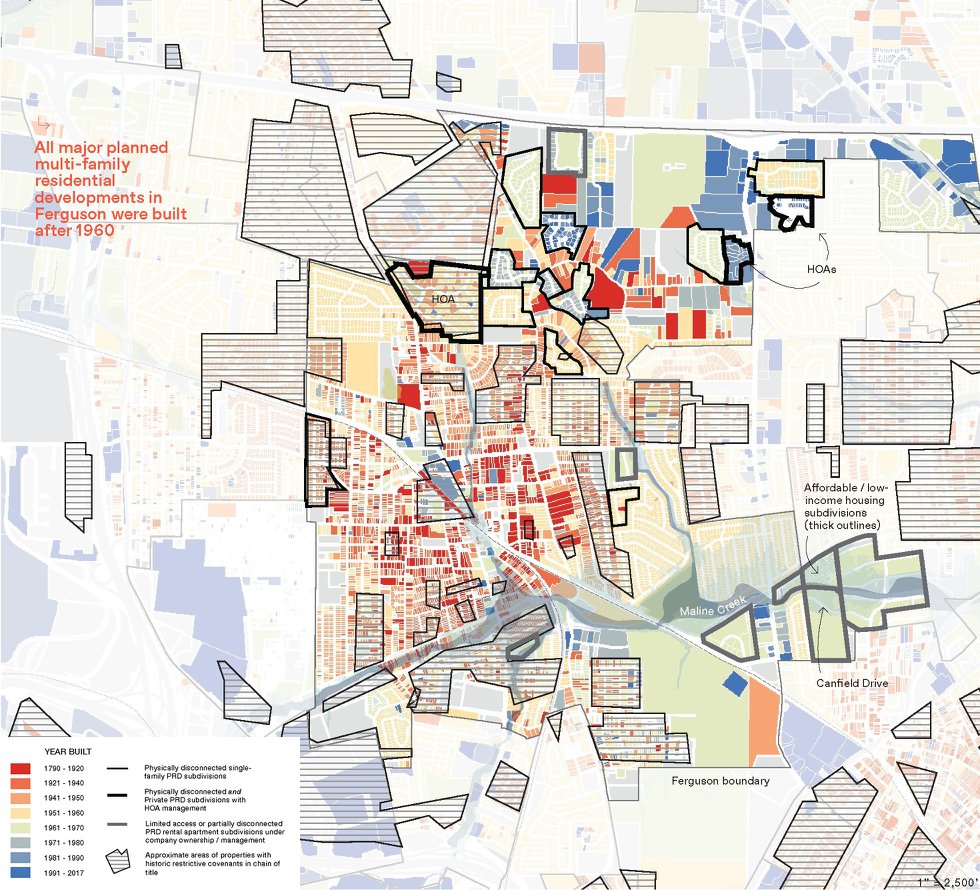
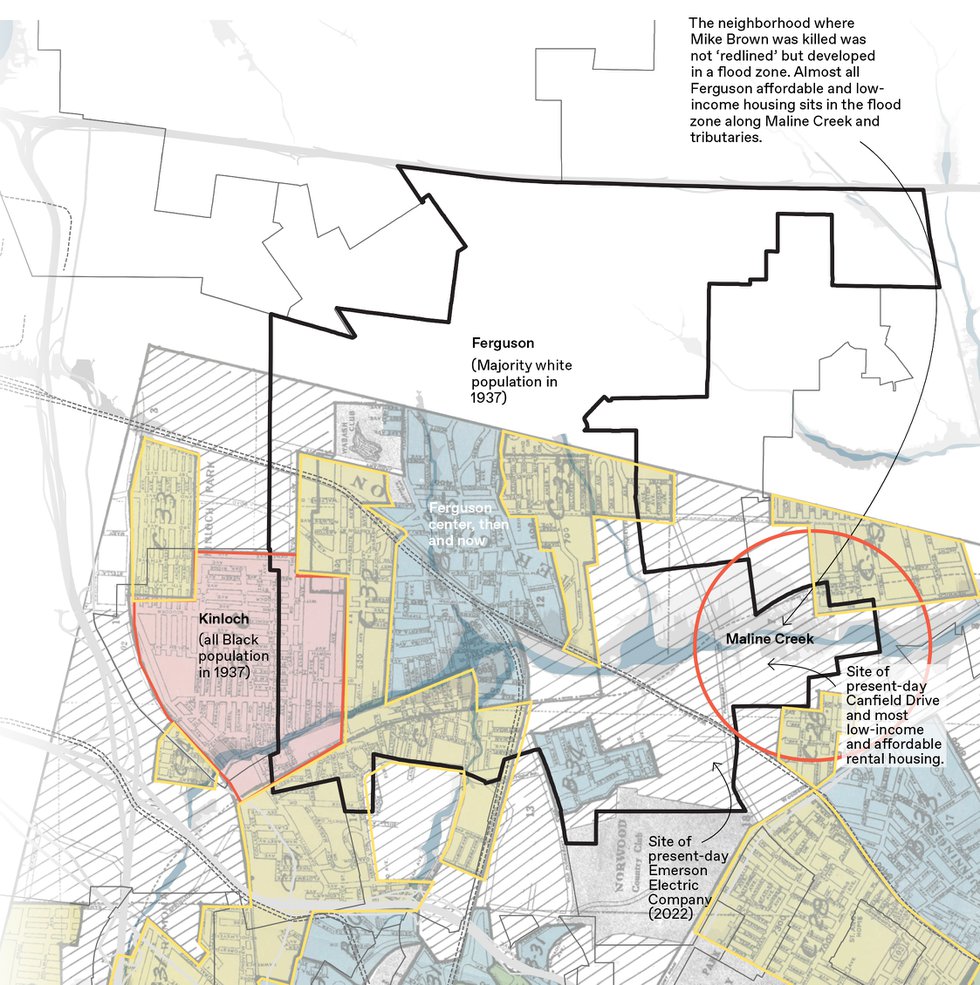
Well, I think it was always going to be maps, because that’s how we know the world. That’s how in my design field; it’s the first thing you do: you draw. I love that you can look at one thing and then cross-reference another thing right on top of it and then see spatially where the hotspots are. Or understand change over time by looking at patterns. I think it’s a great way to show complexity in a very simple format. And one thing about maps is everybody understands maps.
Do you feel like anything has changed since 2014? It’s been 10 years since Michael Brown was killed. Has anything changed for the better, or have things changed for the worse?
I think change hangs in the balance. I try to point out—it’s not explicitly in this book—that we now have a Starbucks [in Ferguson]. That means what? Now we have a solid, stable enough economy that people can go to Starbucks? However, it’s located right by I-270. So you have to look at the spatial aspect of it. It’s targeted for the regional audience, people going by. It really has nothing to do with Ferguson, though it might bring some taxes.
The other changes are the Boys and Girls Club and the Ferguson Community Empowerment Center. Those cannot be understated. They’re great resources there, but they are, to me, a symptom of all the broader underlying systems that have not changed. You wouldn’t need to empower young people if the schools were funded and supported in a way that provided that [empowerment] to begin with.
So that’s part of the point of the book: Underlying systems remain the same, even though we see pockets of new things popping up here and there. They certainly help, but they’re not working toward the big picture.
Do you feel like this book is something that people in other American cities can use?
Yes, that’s my hope. This is about every American city.
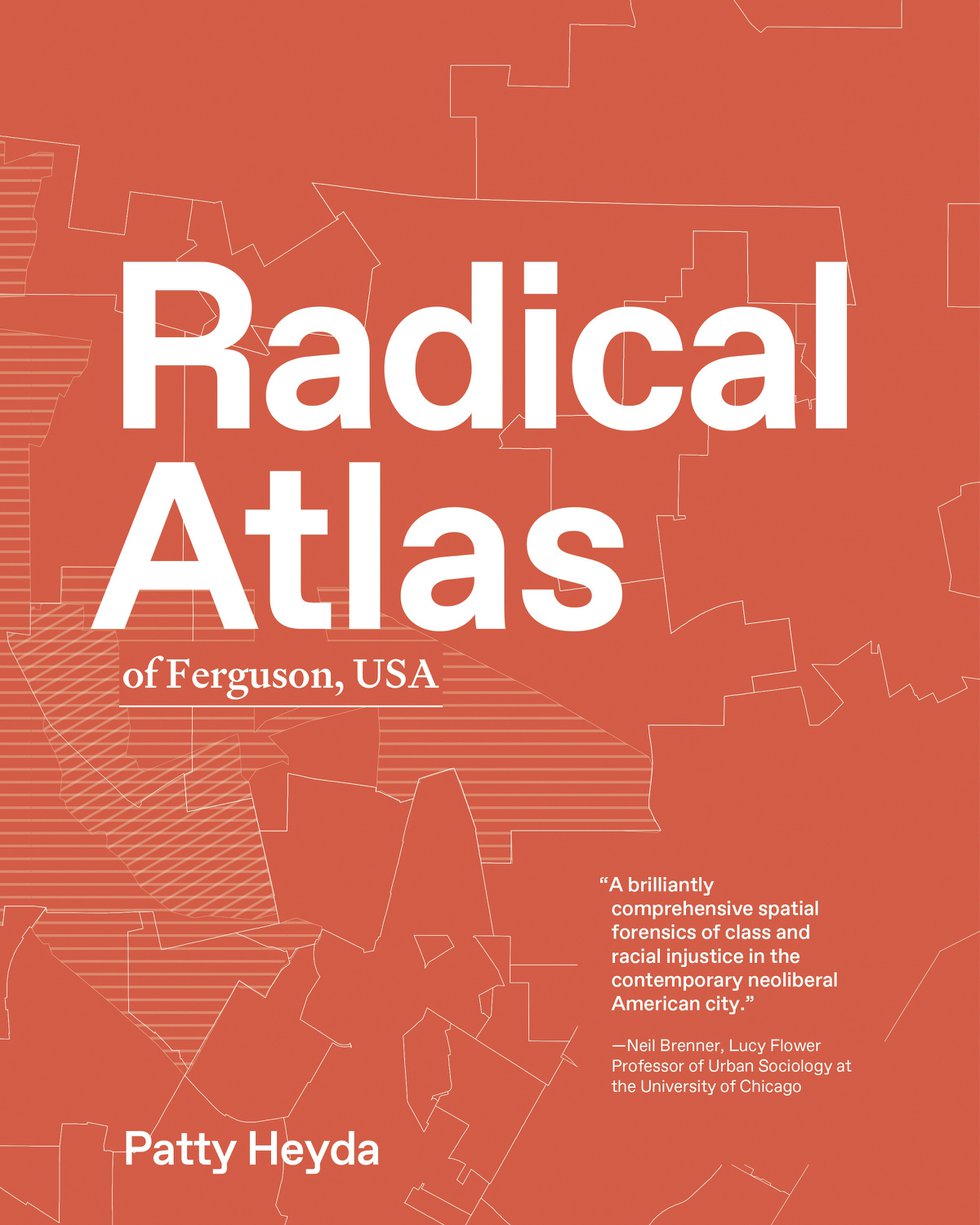
Belt Publishing will release Radical Atlas of Ferguson, USA on August 6.