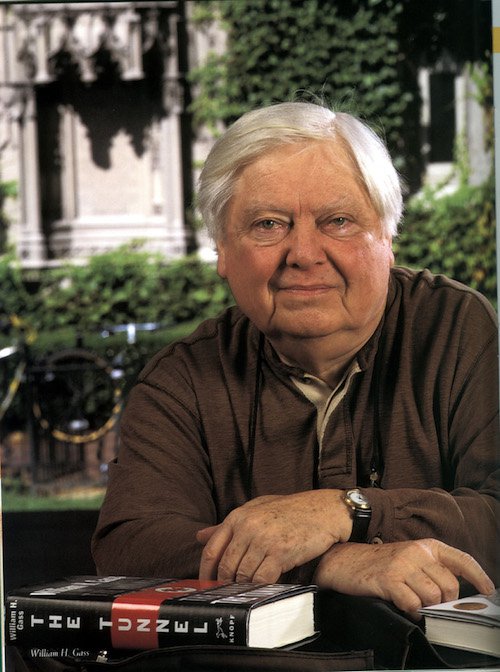
Washington University will celebrate the life and work of William H. Gass—the great American writer and WUSTL professor, who died on December 6, 2017, at the age of 93—with an afternoon of activities on Friday, April 6. If you don’t know about Gass, I suggest you read something else first. This is an appreciation by someone who saw him up close from a handful of vantage points, offered for fellow enthusiasts and to enrich the public record about this transformative intellect and complicated human being. I saw Gass as his philosophy lecture student, which was not unique; his lecture courses were popular, even legendary. I saw him as his creative writing independent student, an almost unheard-of role, given that Gass despised teaching creative writing and, in fact, believed it could not be taught. I saw him as a journalist who made the International Writers Center that he founded into something of a beat, covering most of its moves. I saw him as a traitor to his legacy who served on the board of the Center for the Humanities that replaced his beloved writers center amid some controversy. And I saw him as a fellow writer whom Gass defended—as he was wont to do for writers, in his sly, quotable style—against public attack.
I am sorry I have to be in this story as much as I am, but these were my vantage points. You have to see me to see what I saw.
Stay up-to-date with the local arts scene
Subscribe to the weekly St. Louis Arts+Culture newsletter to discover must-attend art exhibits, performances, festivals, and more.
Gass first fascinated me, not so much for his mind as for his self-possession. He lectured like a rock star. I had never heard of him and was not accustomed to seeing a huge personality and sense of self come in such a small, physically unimposing form. I remember first encountering Gass when I was fresh off the boat, the U.S.S. Saipan, from which I went AWOL in Benidorm, Spain, preparatory to ditching my U.S. Navy ROTC scholarship at Boston University and transferring to Wash. U., right across the river from my hometown of Granite City, Illinois. In my NROTC unit, which was run by burly U.S. Marines, and in Granite City, which was ruled by tough jocks and mean burnouts, there were no small, bookish men or boys with huge senses of self. I remember being struck by Gass as a new kind of being with a form of power, quite dazzling power, that I had never seen before.
The facts are less dramatic. Looking at my transcripts, I took Gass’ Philosophy of Literature course in the spring of my junior year, at the end of my second year at Wash. U., and my first year studying the humanities (after going AWOL from my pre-med studies, two years in; still sorry, Mom). By then, I must have encountered physically unimposing people on campus with intimidating intellects and a show-stopping sense of self. But I remember Gass, who was then 63, as the first. Who is this guy? I had to know. What had he written to make so much out of himself?
After Gass introduced me to most of the writers who burned the deepest into my brain and are still deepest down in there today—Robert Walser, Rainer Maria Rilke, Jorge Luis Borges; damn, Gass’ syllabus was a rock star syllabus—I got around to reading his own work that summer. His short story collection, In the Heart of the Heart of the Country, especially the title story, just knocked me out; I can still remember passages by heart. His first novel, Omensetter’s Luck, stunned me with its opening; bored me in the middle, where a not very fully imagined country preacher character yammers in limerick; then sucked my breath away in its closing movement. His philosophical inquiry, On Being Blue, struck me as being almost perfect. So that’s who this guy was. So that’s where he got his big attitude and gigantic sense of self. He was a great American writer, just one nobody I knew had ever heard of.
I searched for and read interviews with him that summer, where I learned that he taught philosophy because he wouldn’t know what to tell students about, say, the work of Henry James, other than “Look at this!” But, in fact, Philosophy of Literature was basically a great literature course, one of the two best I would ever take (the other was a course on imitatio by Leonard Barkan; read him, if you have not). I figured Gass had sold himself on a story about not teaching literature so he could teach literature. So, when I also read in interviews that he didn’t believe that creative writing could be taught in a class and that he would never teach in a creative writing program, I wondered if he had sold himself on another story and decided to find out, even if it was the hard way.
At the beginning of that next fall semester, the fall of my senior year, I presented myself at Gass’ office in the Philosophy Department and asked him point-blank if I could take an independent study with him on creative writing. He made a face of evident distaste. Gass seemed to share more of his complexities and humanness than most professors. “I have a hard time remembering that graduate students are human beings,” he said, “so, as an undergraduate …” I didn’t take “no” that easily. He caved in and said I would have to look into all of the logistics and fill out all of the forms and leave them for him to sign. I could take it for as many credits as the university allowed, but only if I could take it credit/no credit; he would not grade my fiction. Most vividly, I remember him marching me to the Philosophy office and pointing out a drawer at the very bottom of some tan vertical file of drawers. Since it was at the floor level, I thought of it as a kitty litter pan, absurdly. It did seem intentional that he was giving me a drawer for my fiction on the floor. He said if I would leave the paperwork there and tell the secretary it was there, he would sign it. After that, I should use the same system when submitting and retrieving work.
Though I had joined the U.S. Navy because the recruiter filled out all of my forms for the scholarship and for Boston University, I overcame my aversion—really, a lightweight phobia—to filling out forms, completed them, and left them for Gass. He signed the forms and returned them in my kitty litter drawer. I had a six-credit independent study with Professor Gass for fiction writing, something he doesn’t even teach! I was pretty stoked. I wrote some fiction and left it for him, very satisfied with myself, then told the secretary to let him know it was there. I came back a few days later, very satisfied with myself, and was delighted to find my work had been returned in the kitty litter drawer. I thumbed to the end. I knew from Philosophy of Literature that Gass made few comments on student essays, always at the end.
At the end of my fiction, Gass had written, “Callow, underthought, rethink, deepen.”
So that was how it was going to be?
I kept writing fiction that semester, but never turned in any other work. I even studied with Gass, but never turned in any other work. I never met him again, in the context of that course, but I studied with him by reading his rough drafts in the rare books room at Olin Library, which has his papers. I wouldn’t say that I learned how to write by reading Gass’ rough drafts and how he gradually and painstakingly improved them; the closing paragraph ofOn Being Blue, one of the great episodes in our language, received many workings, getting sadder and more beautiful at every turn. In fact, I came to prefer a more spare, dry prose style and did not end up emulating Gass. But I was impressed at how much hard work went into great writing. And I did think a lot about “Callow, underthought, rethink, deepen,” and how much I had to live and learn before I could write effective fiction. At the end of the semester, hoping for the best, yet fearing a six-credit hole in my transcripts in my senior year, I put my paperwork to get my grade in my kitty litter drawer in the Philosophy office. I imagine Gass was deeply relieved that I had not made him read any more of my “callow, underthought” fiction. He awarded me the credit.
I grew up, though not very much, and became a rock ‘n’ roll singer who did freelance journalism to pay what few bills I had. That’s when I made the International Writers Center my beat, and what a joy Gass was when hosting and praising the greatest writers in the world, many of them his friends. The mists of memory put the Writers’ Center in a bright, windblown chateau, where I am surrounded by Bill Gass and the geniuses of world literature, drinking red wine and taking notes. I believe the center was actually in a basement, though it was lined with much of Gass’ personal library, and it could feel like an enchanted place, and my journalistic service to the center must have been what got me invited to some evening event at Gass’ home, where I drank the first real, red wine of my life, quite a bit of it, so that memory is faded and stained. I can summon an apparition of Bill Gass handing me what seemed like a giant goblet of red wine, as huge as his self-possession in the lecture hall.
I’d best skip quickly past my traitorous support as board member of the Center for the Humanities, which Gerald Early founded in place of Gass’ beloved center, which disappeared. Gerald was much more of a mentor to me than Gass had been, and I enjoyed serving on the new center’s board and respected its new, wider range of programs and priorities, while acknowledging a loss of enchantment on campus and regret that Gass’ vision was gone. I will say I don’t know too many people as close to both centers as I was, since supporters of each tend to divide into enemy camps. Many Gass acolytes and groupies will no doubt have shuddered each time the Center for the Humanities was mentioned in this little memoir, like passing a grave.
But I do want to remember the time Gass defended me, as a writer, from public attack. We both had been recruited to read in support of some literacy project. Kind of clever for a program to benefit literacy, we were asked to perform from a book we had read, but not written. My journalism, both locally and in New York for The Nation magazine, had given me enough local notice to get invited on an A-list bill with somebody like Bill Gass. I should remember what book he read from, but do not. I know I read from The Journals of Lewis and Clark. I was surprised that there was a kerfuffle while I was reading and some people appeared to storm out, after yelling some things at me that probably were not “callow, underthought, rethink, deepen,” but even less approving and more cruel. I couldn’t figure out what it was all about, though.
When I got off-stage, I joined the organizer, Ann Haubrich, and Bill Gass, puzzled. Ann explained that the protestors had not appreciated a passage I had read that described Lewis and Clark encountering some people who hunted an animal and started eating it tartare. I had chosen the passage for its gripping descriptive writing and intensity, without taking or intending any offense at the content. I certainly didn’t see anything wrong with eating red meat raw and knew people who did so (Hasil Adkins, the notorious rockabilly wildman who passed in 2005, comes to mind; when I visited with Hasil in West Virginia, he never consumed anything but raw red meat and white whiskey). Ann explained that the protestors thought the passage painted Native Americans as savages and that it was insensitive, even racist, for me to read it aloud in public.
I looked at her and at Bill Gass, still puzzled. Gass shrugged and clasped my shoulder. “I don’t know about ‘savage,’” Gass said. “To me, they just sounded hungry.”
“William H. Gass: His Life and Legacy” on April 6 will start at 2:45 p.m. in Special Collections in John M. Olin Library with John Biggs, Kathryn Davis, Martin Riker, and Mark Rollins giving remarks, followed by a viewing of manuscripts from the William H. Gass Papers at 3:15 p.m. In Holmes Lounge at 4 p.m., Lorin Cuoco, Michael Eastman, Matthias Goeritz, Garth Risk Hallberg, Joy Williams, and Chancellor Mark S. Wrighton will give remarks, followed by a reception. The remarks in Holmes Lounge will be preceded and followed by a photo slideshow curated by Catherine Gass, adjunct assistant professor of photography at School of the Art Institute of Chicago and daughter of William and Mary Gass.
The event is free and open to the public.