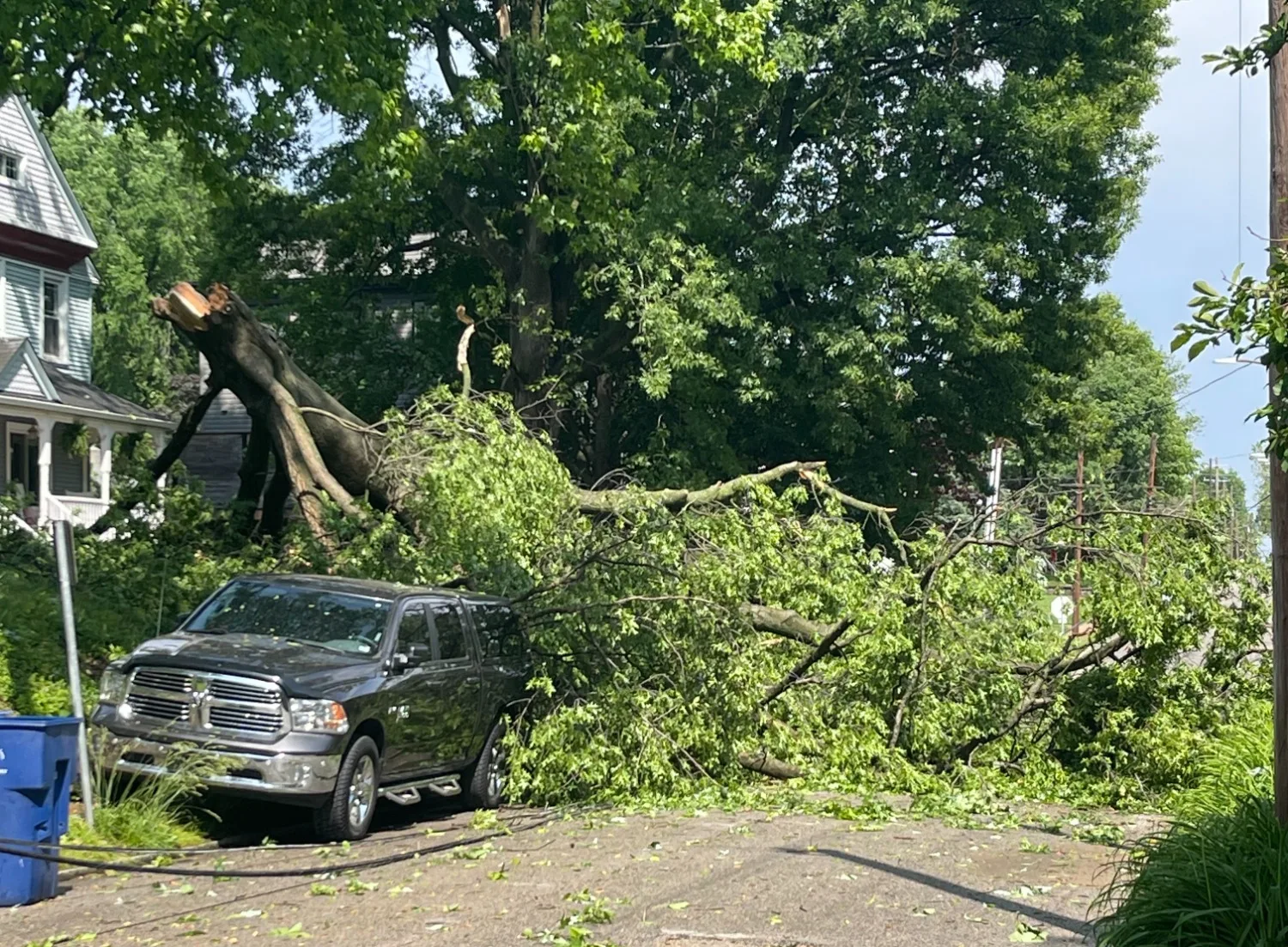
Now that the St. Louis region has received a presidential disaster declaration for last month’s destructive EF-3 tornado, federal resources for recovery can finally start flowing for those in need.
But local mayors worry that the Federal Emergency Management Agency isn’t always prepared to meet the needs of communities before and after a disaster strikes—and high-profile reform proposals coming out of Washington could make the situation more complicated.
Keep up with local business news and trends
Subscribe to the St. Louis Business newsletter to get the latest insights sent to your inbox every morning.
Now, they have an opportunity to directly shape at least one of the reform efforts.
Members of the Mississippi River Cities and Towns Initiative, an association of more than 100 mayors along the river, last week had a call with U.S. Rep. Sam Graves, a Republican who represents northern Missouri, and staff of the House Committee on Transportation and Infrastructure, which Graves chairs.
The discussion centered on the draft of one of the reform efforts co-sponsored by Graves and spearheaded by his committee, the Fixing Emergency Management for Americans (aptly abbreviated ‘FEMA’) Act of 2025.
Along with the committee staff on the call were Hannibal Mayor Darrell McCoy; Melisa Logan, the mayor of Blytheville, Arkansas; Casey Millburg, St. Louis Mayor Cara Spencer’s policy director; and MRCTI executive director Colin Wellenkamp.
The bill proposes significant changes to the structure of FEMA, elevating the apparatus responsible for disaster relief to a cabinet-level agency and tinkering with the way the agency distributes funding and resources, as well as how state and local governments are involved in disaster response and mitigation.
President Donald Trump has made clear his disdain for FEMA, suggesting it’s too expensive, not necessary, and that state and local governments are better equipped to respond to disasters. In March, he signed an executive order directing state and local governments to “play a more active and significant role” in disaster preparation.
But states aren’t necessarily equipped to take on that work, and Graves and his committee’s staff assured those on Friday’s call that their legislation does not aim to gut FEMA.
“The intent is not to mothball FEMA and move a lot of its internal operations to the states,” says Wellenkamp. “We asked them point blank. They said, ‘No, absolutely not. We’re trying to make the programs more efficient, more accessible.”
While Wellenkamp was encouraged by that, he adds it doesn’t mean other reform efforts in the Senate or from the president, including his appointed FEMA Review Council, won’t pursue such changes.
Experts agree there is room to reform FEMA, but largely reject the president’s position that the agency is unnecessary.
“For FEMA to go away, as has been floated by the administration, or to be eliminated in its current form, is not helpful,” says Joel Scata, senior attorney on the Natural Resources Defense Council’s climate adaptation team. “It’s going to leave a lot of Americans wondering where their resources are when they are impacted by a major disaster.”
The draft legislation co-sponsored by Graves would eliminate or streamline some FEMA programs.
For example, the agency’s programs around housing would be reoriented with new provisions on direct assistance and total loss, which Wellenkamp sees alleviating the 18–24 month average it takes to see a reimbursement from FEMA. He says the intention is to move the agency toward direct assistance.
“A reimbursement model takes the most amount of time,” Wellenkamp says. “By the time it gets to the people that were victims of the disaster, they may not even be in the same city anymore. They have completely moved on with their lives by that point and have already gone through tremendous hardship.”
The same can happen for cities too. After major flooding in 2019, the small river city of Grafton, Illinois, didn’t see any money from FEMA until 2022.
The legislation also seeks to eliminate FEMA’s backlog of 800 open disaster declarations, some of which date back decades.
Changes to the way FEMA doles out funding would require state and local governments to be “pretty intensive with their assessments and data gathering,” Wellenkamp concedes.
Yet, more involvement by state and local governments involved in disaster response, recovery, and mitigation isn’t necessarily a bad idea, says Manann Donoghoe, a senior research associate at Brookings Metro, a nonpartisan think tank. FEMA’s current strong funding deployment around recovery (mostly up to 75 percent of eligible costs) may not incentivize states to change policies that could increase resilience to future disasters, he says.
“Which means that their communities can continue to be vulnerable to climate impacts knowing that when there is a disaster the federal government is going to be there to come in,” Donoghoe says.
He, along with NRDC’s Scata, argues FEMA can (and should) do more to help communities build more resilience.
“If the impacts of climate change, these extreme weather events, are going to become more frequent, we’re going to see communities really struggling to avoid some of the worst impacts, unless they can get assistance to adapt,” Scata says, adding that initiatives such as FEMA’s current Building Resilient Infrastructure and Communities program are an important way to help communities adapt.
But that provision is on the chopping block in the draft legislation. Wellenkamp, for one, won’t be sad to see it go.
“We think BRIC, in its current form, is impenetrable, and unobtainable for most of our cities on the Mississippi River,” he says. “The House senior staff agree.”
Wellenkamp says the Congressional staff members on last week’s call were open to suggestions for better mitigation programs and that MRCTI is taking that opportunity to propose one. At this point, the idea would be to have FEMA support large-scale mitigation of disasters by placing a higher value onto projects that span multiple states.
The committee wants to move fast, Wellenkamp says, asking that any recommendations be submitted in two weeks.